Friday, January 22, 2016
What We Do At Mass
What do the people do at Mass that they can't do anywhere else? Why do Catholics have to attend Catholic Mass every Sunday? Why can't we just go out in the woods and commune with God in nature?


Tuesday, January 5, 2016
Monday, November 23, 2015
Last Things
This is the video of last week's RCIA session on the last things: death, judgment, Heaven, Purgatory, Hell, the Resurrection of the Body, etc.
Handouts:
Handouts:
Friday, November 20, 2015
The Church
Here's a recent RCIA session that I taught about the Church:
The Handouts I used are:
The Handouts I used are:
- Fullness of Truth Chart
- Christian Denominations Chart
- Call to Conversion Sheet
- New Testament References to the Church
Sunday, May 31, 2015
Why Catholics Don't Wait Until Adulthood To Baptize
Why do some Protestants wait until they are adults to get baptized?
The difference in our practices stems from the difference in our understandings of Baptism. Since the beginning of the Church, we have understood that Baptism actually affects us. It is something that God does to us. Protestants (in one way or another) have rejected the idea that the Sacraments actually do stuff to us. Depending on the denomination, they may be closer or farther from the full truth of what Baptism does, namely:- Allows us to go to Heaven (CCC 1257, John 3:3-7)
- Forgives all sins (CCC 1263)
- Original sin
- Actual sins (obviously none for babies)
- Punishment due to sin (if you died right then, you'd go straight to Heaven--nothing to be purified in Purgatory)
- Gives new life in the Holy Spirit (makes each person a new creature, CCC 1265-1266)
- Adopted by God as a son or daughter
- Given sanctifying grace (made a partaker in God’s life)
- Given Gifts of the Holy Spirit (Wisdom, Knowledge, Understanding, Fortitude, Counsel, Piety, Fear of the Lord)
- Given Theological Virtues (Faith, Hope & Love)
- Given Moral Virtues (prudence, justice, temperance, and fortitude)
- Made co-heir with Christ
- Made into a temple of the Holy Spirit
- Incorporates us into the Body of Christ (the Church)
- Unites us with each other (CCC 1267)
- Also unites us with non-Catholic Christians (CCC 1271)
- Share in Christ’s priestly, prophetic, and royal mission (1268-1270)
- Priestly - we offer sacrifices to God, uniting them to the Sacrifice of the Mass
- Prophetic - we must help spread the faith
- Royal
- We have the dignity of God’s family
- We are at the service of others (servant leadership)
- We belong to the Church
- We respect the Church’s leaders
- We’re allowed to receive the other Sacraments
- Seals our souls with an unremovable mark (CCC 1272)
- We call this an “indelible character”
- Kind of like branding our souls as “belonging to Christ”
- No sin can erase this mark, but we must still be faithful to it in order to spend eternity w/God in Heaven (CCC 1274)
- This mark is given only once, and cannot be changed or given again
- Consecrates us for religious worship (CCC 1273)
Because we recognize how amazing Baptism is, we want that for our children as soon as possible.
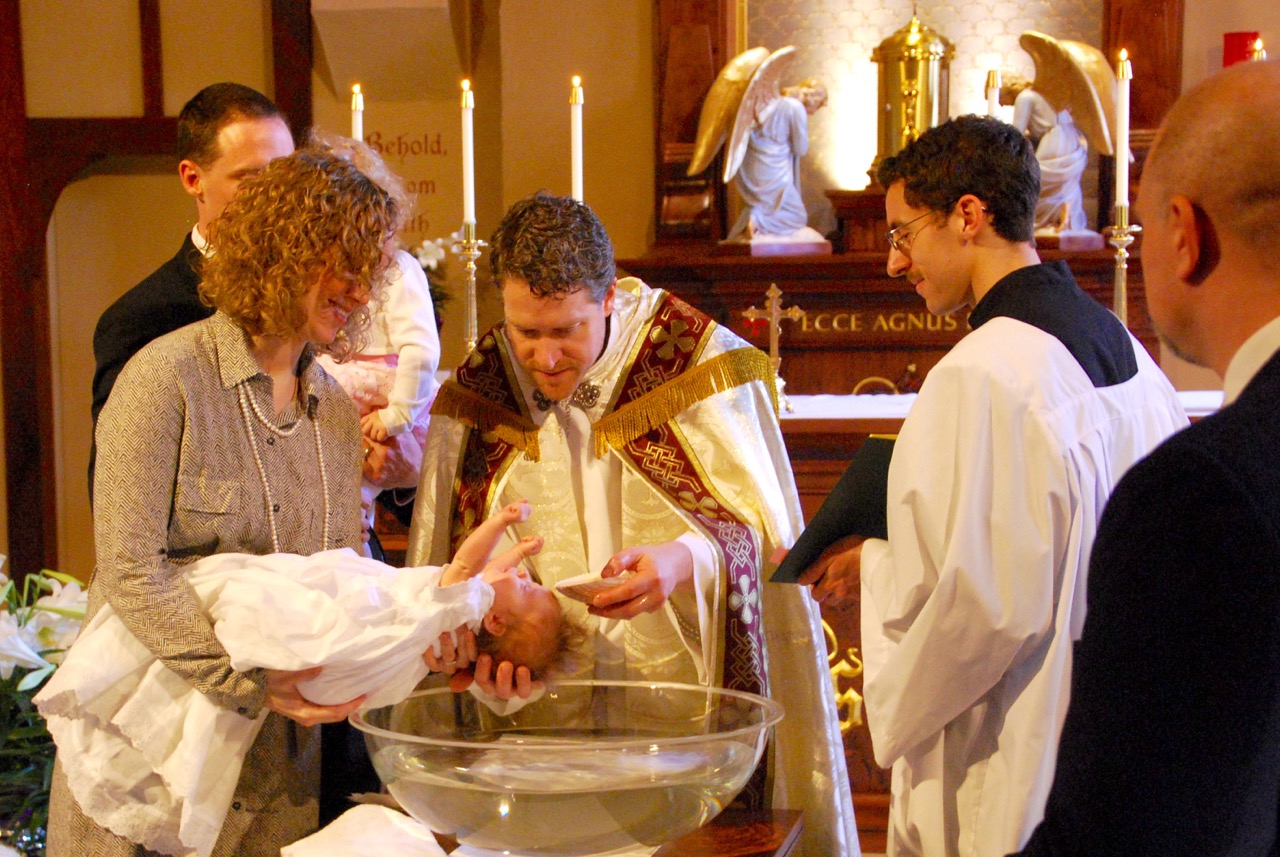 |
| My daughter being baptized |
Many protestants think Baptism is something they do for God (an outward sign of their acceptance of Jesus). Since they don't understand that Baptism does all the above-mentioned stuff for us, they have no reason to baptize until they're older (when they can make an adult decision to accept Jesus).
They also don't find any explicit mention of baptizing infants in Scripture (though multiple times Scripture mentions whole households being baptized at the same time, Baptism clearly is the New Testament fulfillment of circumcision (which happened to babies), and we have explicit 2nd century texts on infant Baptism as a tradition of the Church). Despite these glaring examples, they hold to a strict sola scriptura mentality and reject the idea that infants can be baptized.
What about "re-baptism"?
Since, to many Christians today, Baptism is something they do for God, there's nothing (in their minds) preventing them from doing it again whenever they have fallen away from God and want to re-commit themselves to Him.
If, after Baptism, I want to re-commit myself to God and show remorse for post-Baptismal sins, I would confess my sins in the Sacrament of Reconciliation, and receive Jesus physically in the Sacrament of Holy Communion. Since protestants lack both of these, it is easy to see why "re-baptism" was invented.
"Re-baptism" fails to understand the unremovable mark on our souls--something that can only be given once, and cannot be changed. That is why the Nicene Creed states "I believe in one Baptism for the forgiveness of sins." I can only receive the mark on my soul once. Any future "baptism" is really just me getting wet.
What about Confirmation?
Confirmation is fundamentally different from the Protestant understanding of Baptism.
It is NOT the public act of the person "confirming" (affirming) that he wants to be Catholic, nor as some say "confirming one's life to Christ."
Confirmation confirms (strengthens) the graces we received in Baptism (something God does to us). In our diocese we confirm as early as possible (age of reason: about 7) because we want our children to have the advantage of those strengthened graces in their souls from as early as possible.
The Sacraments affect us. They are not merely outward actions that we do.
Sunday, December 14, 2014
Gaudete
Imagine being a Jew during the 500 years before Jesus. God had set up an amazing kingdom with David and Solomon, but because of Israel’s sins and the unfaithfulness of the people, God removed His protection from the kingdom. First, it split in two from internal division. Then the Assyrians conquered the Northern Kingdom. In 586 BC the Babylonians conquered the Southern Kingdom, including Jerusalem, the palace, and, most-importantly, the Temple. They proceeded to exile the Jewish people, spreading them out across Babylon.
God had promised the Jews that land, and David his kingdom to last forever, yet now the kingdom is destroyed and the people are far from their land. The following years included more wars and changes of power: Persians in 539, Greeks in 336, a brief Jewish revival in 142, only to be reconquered by the Romans in 63 BC. This whole time, God’s people are yearning for the promised Messiah (Christ, “Anointed One”). Where is the Son of David who is to come and rule over all nations? When will God free us from the oppression of these foreign nations?
Now, imagine that you are a shepherd, pasturing his sheep on a late night in Bethlehem. You’re among those Jews, awaiting the Messiah. How shocked and amazed would you be if an angel appeared and told you that the Messiah was born in your town, and that you can go see him right now? Finally! God’s promise has been fulfilled! The Messiah is here, and I can see him!
We live in a similar tension as those Jews today. Who knows what’s going to happen in Iraq? Who knows what the next US election will bring? Even in myself, there is unrest between good and evil. There are prophecies of peace, but we witness war and upheaval. The Church recognizes all this, and still proposes to us this idea to rejoice (gaudete) in the Lord always. Rejoicing isn't merely an emotional giddiness, but an optimism because of our confidence in what God has done, is doing, and will do. Even if times are difficult now, God's justice will triumph in the end. We will see the good that was able to come from our difficulties, and how useless worry and gloominess are.
 |
| Image credit: te-deum.smugmug.com |
We rejoice because not only was the Messiah born, He sacrificed Himself for us. From that Sacrifice are poured forth the Church, the Sacraments, and our very salvation--means for us to overcome our inclination to sin, and live in a relationship with God now and forever, means to draw every man and woman into that relationship. He also promised to come back to us someday and put an end to all evil on earth. This will be the ultimate fulfillment of all prophecies: healing the brokenhearted, freeing captives, making justice and praise spring up before all the nations . . . the kingdom restored and everlasting. No matter how bad things get, in our lives and in the world, we can rejoice because this life is fleeting, but Heaven is eternal, and Jesus invites each of us to have the perfect joy of that eternity with Him.
Today we light the rose candle and don the rose vestments to mark the joy of getting closer to celebrating Christmas. We have passed the half-way point of Advent, our anticipation for the Christmas season is building.
Rejoicing with anticipation,
Casey
Wednesday, December 10, 2014
The Lord Does Not Delay
 |
| photo credit travelsort.com |
Jesus ascended into Heaven almost 2,000 years ago, promising to return. Why is He taking so long to come back? Why doesn’t He just return today and end all the world’s suffering? Is He dawdling? Does He enjoy watching us struggle through life? St. Peter tackled that question in Sunday's second reading: “The Lord does not delay His promise, as some regard ‘delay,’ but He is patient with you.” So God is not dawdling, but He is being patient in His return.
Why the patience? . . . because there are many people who are not in a good relationship with Him. His patience in returning allows those people more time to come back to Him. God does not wish “that any should perish, but that all should come to repentance.” He is giving us all the more time to develop the best relationship with Him possible. That relationship is determined by the way we live our lives. The choices we make to do what is good and true are choices to draw closer to the source of Goodness and Truth: God Himself. That is why Peter continued: “Since everything is to be dissolved in this way, what sort of persons ought you to be?”
When Jesus returns, St. Peter stated, “everything done on [earth] will be found out.” That is, we will all experience the “General Judgement” where all of everyone’s actions, thoughts, words, and omissions from all time will be known by all. God already knows all of this, but now so too will everyone else. We will see all the good and bad effects of everything we’ve ever done. That’s why St. Peter is so emphatic in encouraging us to be “conducting yourselves in holiness and devotion . . . eager to be found without spot or blemish before Him.”
.jpg/1024px-Das_J%C3%BCngste_Gericht_(Memling).jpg) |
| Hans Memling's The Last Judgment, 1471 |
 This is also why all the other readings on Sunday were about “preparing the way of the Lord.” He is going to come back. How is my relationship with Him? Does it need some improvement? If I have “mountains” or “valleys” of sin that need to be “made low” or “filled in,” how do I do that? The answer is surprisingly simple: tell Him. One good Confession will fill in every valley and make low every mountain, standing as an obstacle to a deeper relationship with Him: “Comfort, give comfort to my people . . . speak tenderly to Jerusalem . . . her guilt is expiated!”
Trying to be the sort of person I ought to be,
Casey Truelove
Monday, November 24, 2014
Harvesting Where God Didn't Plant?
 |
| image credit: ucg.org |
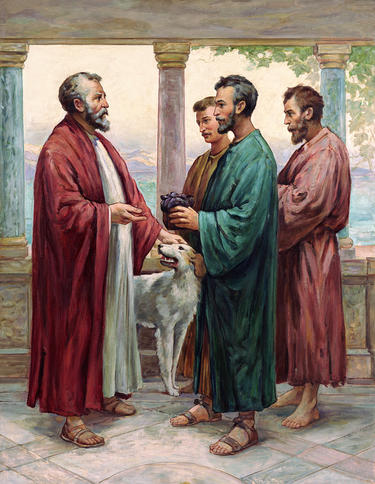
Master, I knew you were a demanding person, harvesting where you did not plant and gathering where you did not scatter . . .Now, the Master obviously represents God, and God is all-good, so we would think that He would naturally pass by these claims that He was stealing, but the Master agrees with the servant:
So you knew that I harvest where I did not plant and gather where I did not scatter?. . . and what do these things have to do with the servant not increasing the money he was given? The Master clearly links them as He continued:
Should you not then have put my money in the bank so that I could have got it back with interest on my return?In wondering about this, some ideas came to me.
We clearly recognize that God isn't a divine investment banker, concerned with worldly riches. After all, He already owns all the money in the world, we just get to use it. The talents, then, as most people easily gather, refer to abilities or opportunities that we are given. These gifts are given to us so that, by putting them to use ("trading with them"), we might draw closer to God and draw others closer to God, ultimately to be happy with Him forever in Heaven.
So what to make of the "gathering where He had not scattered"? Is God just some greedy farmer?
What if Jesus was implying that "where He scattered" was the group of souls of those who would be in His Church (or even those who have been properly evangelized)? If that is the case, we could posit that saying "He gathers where He did not scatter" could refer to the idea that God even gathers people to Himself people who are not visibly part of His Church. This is nothing new. The Catholic Church has always taught that people who don't know God are still drawn by God to Himself via truth, goodness, beauty, etc., and it is even possible for them to be saved. (See Acts 10:35, CCC 843, 847).
If this interpretation can be plausible so far, let's consider why the servant was so wicked and lazy for not "making money." While people outside the visible union of the Church can be saved, it would be much easier for them if they were Catholics (CCC 848-856). Why? . . . because Catholics have two very distinct advantages in the pursuit of a relationship with God: the fullness of the Truth, and the Sacraments.
- Knowing the fullness of what Jesus revealed and has been handed on by the Apostles and their successors about God Himself and how we ought to live provides us with a "detailed map" of how to follow God. Every other person has his own map, it's just not as complete (lacking the fulness of truth) or it may have inaccuracies. It is still possible to draw closer to God, just not as easy. The completeness of any other such map would obviously vary depending on the closeness of that person's knowledge to the Deposit of Faith given to, and handed on by, the Catholic Church.
- The Sacraments give us God's extra helps (graces) on the journey. Baptism wipes away every sin up to that point, makes us God's children, gives us a participation in His Life (Sanctifying Grace), etc. Confirmation strengthens Baptism's effects on us, enabling us to mature in that relationship. Holy Communion is God Himself, and as we consume Him our bodies assimilate Him and He assimilates us into His Body (the Church). Reconciliation forgives sins that we commit after Baptism. Marriage helps us to live a loving, stable family life, and raise more souls to go to Heaven. Holy Orders gives us more men to teach us, govern us, and give us the Sacraments. Anointing of the Sick helps us to remain faithful to God when we are near death, so that we may not despair in the "hour of our death." These graces help us to love more and more deeply both God and neighbor. Effectively, the Sacraments get us on the right path on the "map," bring us back to the path when we stray, help us to see the right path, and continue on it, even when it's tough.
 |
| Image Credit: 1.bp.blogspot.com |
We, too, are given our own talents. Every single one of us has the ability to draw closer to God and to draw others closer to God. We're all called to help scatter the seed of God's Truth (see Lk 8:5-15), increasing the Master's area of scattering and planting, so that as many souls as possible end up loving God deeply and being happy with Him in eternity. This is both a right and a duty. We get to help draw people closer to God, and must help draw people closer to God--for their sake and our own. Of course, the more we love God, the more we will desire to help others know and love Him more, so this duty is gladly accepted. Let us, then cultivate that relationship, study our road maps, and trade for as many talents as we can while we still have time to trade.
Trying to trade my talents well,
Casey
Thursday, July 17, 2014
Trusting God
“Trust in the Lord with all your heart, and lean not on your own understanding.” (Proverbs 3:5) These words are written on a small prayer card given to me by my grandmother when I was young. I read that card many times growing up, but it wasn’t until my young adult life that I really started to learn what it meant and how to do it. Through various trials, the Lord has been showing me a way to a deeper union with Him: trust. Many times God has taken something away from me, only to draw me closer to Him--and often give me something better than what He took. He has called me to trust Him with what He was doing, and be open for what He has next.
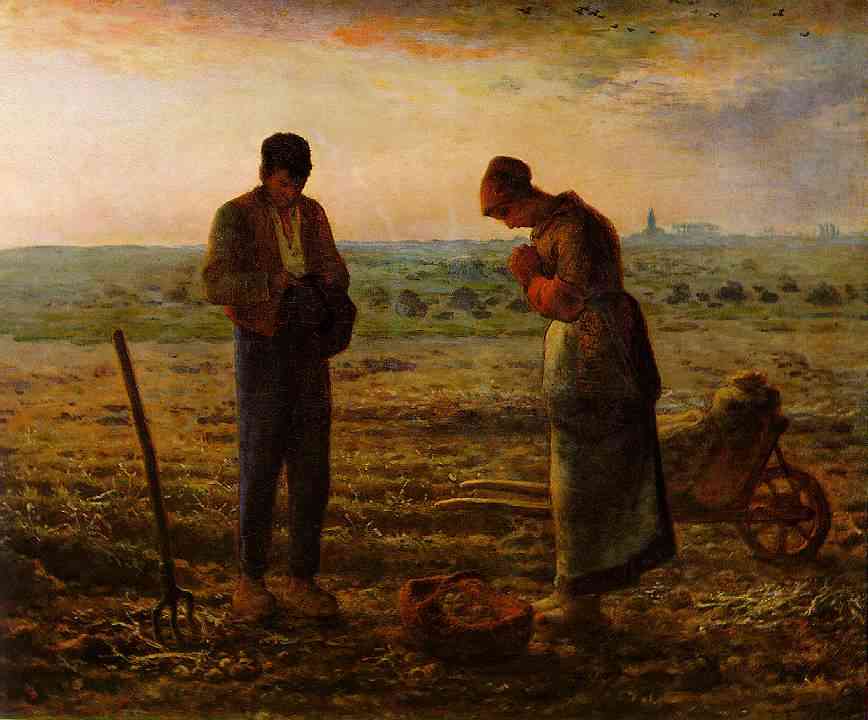 At the dawn of our marriage, the Lord put on the hearts of my wife and I the desire to raise much of our own food. The dream was to raise enough money to someday buy a house with enough land to homestead on the side while teaching theology for my day job. Two years ago, we came across the New Catholic Land Movement, and after reading Kevin Ford’s material, I decided to contact him and compliment his work. Much of what he wrote had spoken to my wife and I (in fact, we had backed up to the beginning of his blog in order to read the whole story). Quickly a friendship developed between our families, and (long story short) the Fords invited us to join them on their farm.
 This was a big leap for Amanda and me. We were going to leave a comfortable theology teaching job in Austin, TX to move to the-middle-of-nowhere, KS, to become co-owners of a farm (for which neither of us had any experience). Nonetheless, both of us felt God leading us in this direction. All of us had ideas of bringing more families onto the land, and starting an institute for rural Catholic life, where we could pass along not only farming know-how, but theology as well (Kevin is also a former theology teacher). This was it: God was giving us our “in” for the agrarian life. Of course, this was all much sooner than we had expected, but with God, I’ve learned over and over again to just follow His timing, and things will turn out better than I could have ever imagined.
After a year of farming, door after door was closing for getting housing for other families who wanted to move out with us. Dreams of an agrarian Catholic cultural revival in this small town were seeming more and more distant.

Beyond that, farming was getting tougher and tougher. On the heels of the worst drought years on record, we had a spring drought this year. Summer drought is one thing, but spring drought is a farm-killer. Mature plants respond much better to irrigation in the middle of a drought than seeds and seedlings--most of which we couldn’t even get into the ground because there was no rain to soften the soil enough for us to effectively till. If it weren’t for our greenhouses, we wouldn’t have had any spring crops. All of our summer crops were pushed back drastically.
And problems didn’t stop there. A literal plague of grasshoppers (probably multiple millions of them) descended on our farm. This happened last year and wiped out half of our crops. After they died down at the end of last season, we spread NOLO Bait at 10 times the recommended level, we put pigs in some of the areas where they had bred, so they would root up the dirt an eat any grasshopper eggs therein. We also released guinea fowl and ducks on the farm to eat the assaulting insects. Alas, however, they came back worse this year. Not to mention the drastic increase in tomato horn worms and squash bugs.

All told we will probably lose 80-85% of our crops this year. Ugh! Because of this our farm will not be able to bring in enough income to support our families through the rest of the year. We already knew that it would be difficult because we rely mostly on subscriptions to our delivery service, and we were only able to sign up about half the number of patrons we needed to survive the year. As it is, we are already going to have a difficulty giving those few customers enough produce to offset the money they invested. We started seeing the writing on the wall about a month ago. Our two families met for a heart-to-heart discussion, and we decided to pray about where God is leading each of our families (and whether we should close the farm after this season).
Initially, we were shocked, sad, and really felt bad for our customers invested in us and who rely on us for good food. We also didn’t know what we were going to do with the fixer-upper house we bought.
Again, I had to rely on that passage from Proverbs: “Trust in the Lord with all your heart, and lean not on your own understanding.” I had to trust God that He brought us to Kansas to farm, and that He allowed the natural disasters to occur to push us on to the next step in His plan for us. I could not “lean on my own understanding.” I don’t have the vision that God has. I could not immediately understand all His motives for allowing what He has allowed. Whatever that plan was, I had to trust that He would make it happen. Thankfully, He has put me through many similar situations (though perhaps not on this scale), so I was a bit prepared. Through this whole ordeal, I’ve felt like His little lamb from Psalm 23:

The LORD is my shepherd, I shall not want; he makes me lie down in green pastures. He leads me beside still waters; he restores my soul. He leads me in paths of righteousness for his name's sake. Even though I walk through the valley of the shadow of death, I fear no evil; for thou art with me; thy rod and thy staff, they comfort me. Thou preparest a table before me in the presence of my enemies; thou anointest my head with oil, my cup overflows. Surely goodness and mercy shall follow me all the days of my life; and I shall dwell in the house of the LORD for ever.
I’ve felt God’s assurance close by me this whole time, and I knew that I just needed to trust Him.
Knowing that God often wills for us to help each other in completing His will, I also reached out to some close friends and family who I knew would pray for us. Amanda and I began the novena (nine days of prayer) to the Sacred Heart of Jesus, and asked them to pray along with us. The very next day, my friend, Jeremy, told me that the position He just left (in order to attend grad school) had yet to be filled, and that we was going to pass my name along to the pastor. This position is the Director of Student Outreach at St. Mary University Parish on the Campus of Central Michigan University. The following day, the pastor contacted me. In the past, it has always been a good sign of where God is leading me when an opportunity reaches out to me instead of me gaining something on my own. As my former spiritual director advised me, “you paddle, and let God do the steering.” In those situations, I have been forced to be weak (letting God bring the opportunity to me on His own terms and timing) rather than strong (me aggressively pursuing the opportunity). I couldn’t help but think of 2 Corinthians 12:9-10:
but He said to me, “My grace is sufficient for you, for my power is made perfect in weakness.” I will all the more gladly boast of my weaknesses, that the power of Christ may rest upon me. For the sake of Christ, then, I am content with weaknesses, insults, hardships, persecutions, and calamities; for when I am weak, then I am strong.
Then weak I must be, and be it gladly--for I must realize that whatever God has for me is better than anything I can bring about on my own. Further I dove into my times of prayer, beseeching God for His guidance and clarity (for both me and the parish). If this opportunity panned out, I would be able to fulfill my passion of imparting the faith to young adults (how I got started in ministry/theology back in 2001). Also, I would only be 2 hours from my hometown, with many friends/family (including my best man) within an hour. We would also only be 5 hours from most of Amanda’s family. Up to now, we have never (in our married life) lived less than 6 hours from any family. Through all the places God had brought us, I had always pined for the beauty of Michigan. After having spent the first 31 years of my life in Michigan, I haven’t stepped foot on the sandy shores of a Michigan beach. After spending so many of my summer days swimming in Michigan’s clear, sand-bottom lakes and bays, I have rarely swam in the dirty muck-bottom waters of Iowa, Texas, and Kansas. It would be a dream come true to return to my native land, and to be able to teach my kids to swim in those same waters where I learned. But would it be?
Trust, I must, and wait. Ah! So many of God’s plans involve us waiting, being more and more patient, continually offering up the sacrifice of not knowing and not being able to actively do anything but pray. As the novena went on, we had multiple contacts with the pastor. Then on the Solemnity of the Sacred Heart of Jesus, he called me and set at ease some of our concerns about how much I could earn--ministry jobs aren’t known for their ability to provide the single income for a family, but he was able to make it work. He also, in that same conversation, offered to “move things to the next step:” an interview via Skype with multiple members of the parish. There was just one hitch: we had to wait two more weeks for one of them to return from vacation. Again, we were back to being refined in the fires of waiting to form the virtue of patience.
This time was not without its own highlights, though. During the novena, our next door neighbor, Aaron (Kevin’s brother) had heard that we were going to move, so he walked over and offered to buy our house. Not only that, but since he’s a carpenter, he offered to buy it “as is,” and he will finish our work, meaning we could stop and focus on more important things. We are still waiting to find out what will happen for my in-laws and their fixer-upper house next door, but I’m sure God has a plan for that, too.

Prayer works, I’m telling you! “Pray, hope, and don’t worry!” - St. Pio
But wait, there’s more: I wrote to an acquaintance I had met through Jeremy, who is a member of the parish. I wanted to know if he knew anything about housing in the area. He responded, and get this: not only does he go to the parish, but the pastor asked him to be on the interview committee, and he happens to own a duplex that might just come up for rent right when we need a place. Not only that, but the other side of the duplex is going to be rented to missionaries with whom I will be working! Yes, God provides:
"Therefore I tell you, do not be anxious about your life, what you shall eat or what you shall drink, nor about your body, what you shall put on. Is not life more than food, and the body more than clothing? Look at the birds of the air: they neither sow nor reap nor gather into barns, and yet your heavenly Father feeds them. Are you not of more value than they? And which of you by being anxious can add one cubit to his span of life? And why are you anxious about clothing? Consider the lilies of the field, how they grow; they neither toil nor spin; yet I tell you, even Solomon in all his glory was not arrayed like one of these. But if God so clothes the grass of the field, which today is alive and tomorrow is thrown into the oven, will he not much more clothe you, O men of little faith? Therefore do not be anxious, saying, 'What shall we eat?' or 'What shall we drink?' or 'What shall we wear?' For the Gentiles seek all these things; and your heavenly Father knows that you need them all. But seek first his kingdom and his righteousness, and all these things shall be yours as well. "Therefore do not be anxious about tomorrow, for tomorrow will be anxious for itself. Let the day's own trouble be sufficient for the day. (Matthew 6:25-34)
No wait, there’s still more: A few days later, we found out that Amanda is pregnant! So, counting our little Simon Peter (in Heaven) and Miriam Ruth (on Earth), we have Baby Truelove #3 due March 3rd! We again deepened our prayers.
 Amanda came across another novena that was coming up: that to Our Lady of Mount Carmel. Both Amanda and I wear the Brown Scapular as a sign of our devotion to Jesus through Mary, who gave the scapular to St. Simon Stock on Mount Carmel July 16th 1251, so this is a prominent Memorial for both of us. We don’t normally pray back-to-back novenas, but this time it seemed appropriate. We prayed both to get the job and for the health of the baby (having lost Simon Peter, we’re particularly sensitive to baby health).
We're still waiting to hear on some opportunities the Fords might have for future employment, but we trust in God's providence there, too.
So let’s recap: God took away the farm, only to bring me: 1) a new job, returning to my passion of teaching theology to one of my favorite age groups, 2) a return to my beloved state of Michigan, 3) a buyer for my house, 4) a potential place to live, and 5) a new baby. God is so good! I encourage you, if you are in any trial now (or in the future): place your trust in Him. Yes, I know it’s scary. I know you’ll probably have to let go of something(s), but He has a plan for you. Yes, He has a plan for you--not just me or some other guy: you. He wants to give you something even better for you (that which will draw you closer to Him and will draw other souls closer to Him through you), if you let Him. The question is: “Are you going to lean on your own understanding, or are you going to trust Him?”
Always trying to trust more and more,
Casey
Sunday, November 3, 2013
We Only Keep the Photos We Like

Yesterday, my family went to a park, and we took many photos. The photo above stood out, however, as particularly beautiful in how it captured the expression of pure joy as my daughter, Miriam, experienced swinging for the first time.
Later in the day, my wife and I sorted through all our shots and kept the few that we really liked. This particular shot stood out as beautiful. I recalled how during my childhood years my family would occasionally look back through photos and I would see pictures of myself as I grew. I started to look forward to giving my daughter this opportunity to look back at some beautiful pictures of her childhood.
Through all this, a simple thought struck my mind that really made me think: We only keep the photographs we like. Out of all the photos my wife and I took, we only kept the ones that were beautiful--that moved us in some way. The ones that were blurry or had awkward poses or strange faces were moved to the trash. I thought back to the first time I purged my collection of photographs from boxes and albums. At that time, these were actual, tangible photographs, taken with film and printed on paper. Now, it is simply a matter of deleting an electronic file. I realized then that I didn’t have to cling on to every single snapshot of my past. I have taken thousands and thousands of photos throughout my life, but I only have certain ones that I have retained--only the best ones, the most beautiful and/or the most important.
God’s Photos
Just as we only keep the photographs we like, God desires to keep only the good memories of us. He wants only pictures that He likes, and He offers us the opportunity to get rid of those less-than-stellar shots through Confession. In this act of repentance, we choose to accept His opportunity to turn away from whatever evil we have committed in thought, word, action, or omission. He said to His Apostles (the first Catholic priests): “If you forgive the sins of any, they are forgiven; if you retain the sins of any, they are retained.” (Jn 20:22) God continues to give us Catholic priests today, who are given this power to act as His instruments of forgiveness. God wants to get rid of those blurry, awkward shots from our lives. He wants to only see a life of beauty in each of us, but we have to take Him up on His offer. We have to admit we have done wrong and try to not sin again.
Our Photos of Others
We also have to do the same for others. God said that in order to be forgiven, we must forgive others.
“Forgive us our trespasses as we forgive those who trespass against us . . . For if you forgive men their trespasses, your heavenly Father also will forgive you; but if you do not forgive men their trespasses, neither will your Father forgive your trespasses.” (Mt 6:12, 14-15, emphasis mine)
So, God wants to get rid of the bad pictures of us, but we first need to get rid of the bad pictures we have of each other. He wants us to look at the good in others.
Rather than focussing on the crazy times when Miriam’s teething drives her to bouts of crying that seem unconsolable or focussing on how many hours of sleep we have lost (Amanda more so than me), my wife and I are called to focus on the good in Miriam (like re-viewing this picture of her) . . . and those aren’t even sins! We have to be willing to get rid of those bad photos we hold against others for their offenses. I have to recognize that I’m still holding a grudge against someone: my wife, my brother, my sister, my parents, my relatives, my friends, people at work, in the community, etc. What have they done that I still hold against them? In justice, I naturally want to see something done about this, but in mercy, I need to follow God’s lead and forgive these people. I cannot condone sinful activity, but I must love sinful people (like me).
The Final Album
Eventually, God willing, we will be with God forever in Heaven. In that state there won’t be any bad pictures, only the best. Before we can get there, however, we must go through a final touch-up, a final purging of bad pictures, a purification. St. John told us that nothing unclean can enter Heaven. (Rev. 21:27) So we cannot enter without these pictures being removed. This final purging of the stains of sin is what we call Purgatory.
In the end, those who have “feared God and done what is right” (Acts 10: 35) will be with Him forever. All in Heaven will glorify God’s mercy for forgiving their offenses. They will marvel at His mercy, for He has kept only the best photos.
Trying to keep the best photos,
Casey
Thursday, September 5, 2013
Would A Human Clone Have A Soul?
One of my previous students recently wrote me, asking about human clones:
If a person is ever cloned, does that living being have a soul? Can we say that God made that person, and that despite being cloned by man, is still a unique individual? Should a clone of a person have the same rights as a person who is, well, the original? Would it be a sin for a person to allow themselves or to allow others to be cloned?
The following is my response with some additions:
To answer your question: every human person has a unique, unrepeatable soul, no matter how he/she came to be. The means by which a human clone came into existence would be evil (assuming that scientists are actually able to figure this out, and one day do), but the person him/herself would still have all the rights as anyone else (just as a person who was conceived in a test tube or in rape would have been conceived in an evil way, but would still have his or her own unique soul with all the rights as anyone else).
If a human is alive, he must have a soul, and souls only come from God. St. Thomas Aquinas wrote:
the soul is defined as the first principle of life of those things which live: for we call living things "animate," [i.e. having a soul], and those things which have no life, "inanimate." (Summa Theologia I.75.1)
the human soul is produced by God (Summa Theologia I.75.6)
Like all moral situations God gives us free will to do things the right way or the wrong way. Rape, artificial insemination, sex outside of marriage, and cloning are all wrong ways of bringing a human being into existence. God also allows all the consequences of our actions (good or evil), so He just might allow these evil situations to be effective in their natural consequences (creation of a new human life) by creating a soul to animate the body these people are forcing into creation--even though these means are against His design.
Yes, you're right. People who practice things like artificial insemination and cloning are (knowingly or unknowingly) trying to be as great as (or greater than) God. They're taking a place that belongs to God in the human reproduction process. Every human being has the right to be the fruit of the loving act of his/her mother and father (c.f. CCC 2378). God designed humans to be the natural result of a loving marriage, not the result of scientific processes. Any act that creates a human being outside of the marital act, then, is evil (contrary to God's design). It would also be a sin for a person to willingly have him/herself cloned (for the same reasons).
The only exception for this is, obviously, natural cloning (a.k.a. twins). If I remember correctly, I think I heard somewhere that identical twins (or was it fraternal twins?) are considered clones of each other because of the way they develop in the womb. That's something about which an embryologist would a have much better understanding, so don't quote me on it.
Some might try to argue that if clone has a soul, and God created the soul, this must be proof that God thinks cloning is okay. Again, we refer back to the fact that God allows the natural consequences of all of our actions (good or bad). If I jump off a tall building, God will let me die (no matter how good or evil of a person I am) because death (separation of the soul from the body) is the natural consequence He has set up for things like falling from high places. If I steal food from a restaurant, it will still taste the same as if I had bought it honestly. God would not be allowing it taste good because He condones my theft; rather, He would allow the experience of the good taste of the food to be a natural consequence of putting good tasting food in my mouth. Too often, people try to excuse their evil actions because they do not see an immediate reaction by God (like lightning bolts shooting out of the sky to kill them for doing whatever they did). They're just fooling themselves into thinking their activity is okay.
[P.S. It's been over 6 months since I posted because things have been a little busy: I have a 5 month-old daughter, I moved from Texas to Kansas, and I switched from teaching theology to farming--see also the New Catholic Land Movement]
Saturday, February 16, 2013
How is the Pope Holy?
A friend wrote to me on Facebook, asking the following question:
. . . how is the Pope considered a 'holy man' when he is elected by a group of individuals? It seems too Democratic a system to be pure and holy.
I enjoy when friends ask questions because they often ask questions that go beyond the scope of what I have already studied, so I have to do more research to learn exactly what the Church teaches on that particular topic. I was intrigued to begin to formulate an answer to this question, because I had been wondering about part of it myself--specifically, what the Church taught about God's role in the election of the Pope. I believe I was able to make a good start, but I think there is probably much more I can learn about this topic. Feel free to comment if you know any more than I have already listed.
What follows is my response:
1) How is the Pope a “holy man?”
 |
| Photo Credit: catholicism.about.com |
First, it will help to understand the word holy. We use “holy” in multiple ways, particularly to describe the following:
- A: God Himself
- B: A person, place or thing consecrated to God (set aside as belonging to God)
- Gen 28:16 - the place God appears
- Ex 19:6 - God’s people
- Ex 28:43 - the Tabernacle
- Is 48:2 - Jerusalem
- Lev 10:17 - the sacrificial goat
- Rom 1:7 - what Christians call each other
- C: Someone who has an outstanding relationship with God and lives an exemplary moral life. (This is probably the most common use in our ordinary vocabulary.)
We also use other words that mean holy: sacred, saint, hallowed, blessed, etc.
We call the pope “the Holy Father” because of his particular position (his office). In Mt 16:18-19, Jesus said to St. Peter that he was “Rock” [Jesus changed his name from Simon to Kephas (Aramaic for “rock”) --> Petros (Greek feminine for “rock”) --> Petre (Greek masculine for “stone”) --> Peter (English transliteration)] and on this “Rock” He would build His Church. At this point Jesus also promised to Peter the Keys to the Kingdom of Heaven [a symbol of Jesus’ authority being handed on to Peter to be “in charge” after Jesus ascended--when the Old Testament King was going away, he would give his prime minister the keys to the kingdom to show that he had the authority while the king was gone (see Is 22:20-22)]. Catholics see this as Jesus establishing Peter as the head apostle, who after the Ascension would have Jesus’ authority to lead the Church. Peter left James in charge as the “bishop” (from the Greek episkopos or “overseer”) of Jerusalem and moved on temporarily to Antioch. Peter eventually settled in Rome, where he spent the rest of his life. Peter helped to begin and grow the Christian community in Rome. After Peter was crucified, the remaining Apostles and other bishops knew that someone needed to take Peter’s place just like Matthias had been appointed to take Judas’s place (see Acts 1). Linus was appointed to take Peter’s place as not only the bishop of Rome, but also the new head of the whole Church. Since then whoever was the bishop of Rome was considered the head of the Church (Benedict XVI is the 265th bishop of Rome).
Because his position is to lead the faithful closer to God, he is called the “Holy Father” --> the “papa” --> the “pope.” This corresponds mostly to definition B (above) for holy. He is “holy” by virtue of the fact that his office dedicates him totally to God, and he is acting with God’s authority in that position. He acts in the person of Jesus as the earthly head of the Church, so we also call him the “Vicar of Christ” (vicarius is Latin for “in the person of”).
Ideally, we can also apply definition C to the pope: that he is a moral role model. We have been very fortunate to have recently had a string of some very definition-C-holy popes. Some popes have not been very morally upright (Leo X comes to mind), but the REALLY cool thing with that is this: even though there have been some really morally lousy popes in the past, God has prevented all of them from changing official Church teachings to say that those bad things are good. God wants His people to always have access to the correct teachings about Him (faith) and how we ought to act (morality), so He prevents the popes from changing the teachings that Jesus handed on to the Apostles, who handed it on through history to us today. The popes don’t necessarily get any extra knowledge, but because God wants us not to be led into error, the Holy Spirit prevents the pope from changing the teachings. This can be seen in that same passage from Matthew: both in the authority of the keys, but also when Jesus told Peter that whatever he “bound on earth will be bound in Heaven, and whatever he loosed on earth would be loosed in Heaven” (“binding” and “loosing” were terms used by rabbis both for doctrine and for the forgiveness of sins). This is what Catholics mean when they say the pope is “infallible.” He is not made “impeccable” (without sin), but he is prevented from changing the truth that Jesus handed on. It has been such a blessing that Benedict XVI and John Paul II were such holy men in all accounts, but not every pope has been that way.
2) Does the election of the Pope make him holy? Isn’t it a rather fallible human system?
 |
| Photo Credit: Fotographia Felici |
Analogously to Jesus Himself, in the election of the Pope there is a certain combination of the human and the divine. Yes, the cardinals are men, electing the next pope, but they are called to pray for God’s help. Pope Paul VI described it in his document on the Election of the Roman Pontiff (#84):
Like Our predecessors, We strongly exhort the cardinal electors not to be guided by likes or dislikes in electing the pope, nor influenced by the favor or compliance of anyone, nor moved by the interference of persons ... nigh places or pressure groups, or by the suasive language of the masters of the communications media, or by violence or fear or love of popularity. Instead, with God's glory and the good of the Church as their sole guide, and having asked for divine help, let them vote for him whom they judge most fit to rule the universal Church in a fruitful and useful way.
In the next paragraph, Paul VI also recognized that all the Catholic faithful around the world are called upon to pray for the cardinals in the conclave, so that they may be open to listening to God’s direction. While it is open to human fallibility, the conclave of cardinals electing the new pope is called upon to open themselves to God’s direction. And even if they don’t, and the worst pope in history is elected, we can trust in Jesus’ promise to Peter in that same quote that the gates of hell will never prevail against the Church. Whomever they elect will be the new bishop of Rome, and God will help him in guiding the Church. Even if the man is not definition-C-holy, he will be by default definition-B holy. We pray for both B & C.
UPDATE (3/1/13): A friend linked me to this article at the Deacon's Bench, quoting Cardinal Ratzinger 8 years before he became pope:
I would not say so, in the sense that the Holy Spirit picks out the Pope. … I would say that the Spirit does not exactly take control of the affair, but rather like a good educator, as it were, leaves us much space, much freedom, without entirely abandoning us. Thus the Spirit’s role should be understood in a much more elastic sense, not that he dictates the candidate for whom one must vote. Probably the only assurance he offers is that the thing cannot be totally ruined . . . There are too many contrary instances of popes the Holy Spirit obviously would not have picked!
I hope this helps. If you have any questions, feel free to ask.
Again, if any of you have any good quotes on God's guidance of the papal electors, please share.
Praying for our current and future Holy Father,
Casey
Subscribe to:
Posts (Atom)