Showing posts with label Heaven. Show all posts

Monday, November 24, 2014

Harvesting Where God Didn't Plant?

image credit: ucg.org
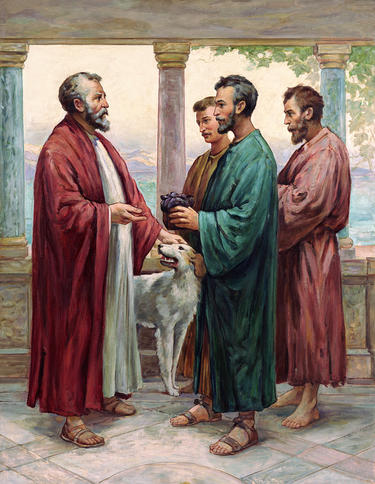
At Mass last week, Catholics heard the Parable of Talents (Matthew 25:14-30). There's always something a bit odd about this reading to me: the wicked, lazy servant's description of the Master. He stated:
Master, I knew you were a demanding person, harvesting where you did not plant and gathering where you did not scatter . . .
Now, the Master obviously represents God, and God is all-good, so we would think that He would naturally pass by these claims that He was stealing, but the Master agrees with the servant:
So you knew that I harvest where I did not plant and gather where I did not scatter? 
 . . . and what do these things have to do with the servant not increasing the money he was given? The Master clearly links them as He continued:
Should you not then have put my money in the bank so that I could have got it back with interest on my return? 
In wondering about this, some ideas came to me.

We clearly recognize that God isn't a divine investment banker, concerned with worldly riches. After all, He already owns all the money in the world, we just get to use it. The talents, then, as most people easily gather, refer to abilities or opportunities that we are given. These gifts are given to us so that, by putting them to use ("trading with them"), we might draw closer to God and draw others closer to God, ultimately to be happy with Him forever in Heaven.

So what to make of the "gathering where He had not scattered"? Is God just some greedy farmer?

What if Jesus was implying that "where He scattered" was the group of souls of those who would be in His Church (or even those who have been properly evangelized)? If that is the case, we could posit that saying "He gathers where He did not scatter" could refer to the idea that God even gathers people to Himself people who are not visibly part of His Church. This is nothing new. The Catholic Church has always taught that people who don't know God are still drawn by God to Himself via truth, goodness, beauty, etc., and it is even possible for them to be saved. (See Acts 10:35, CCC 843, 847).

If this interpretation can be plausible so far, let's consider why the servant was so wicked and lazy for not "making money." While people outside the visible union of the Church can be saved, it would be much easier for them if they were Catholics (CCC 848-856). Why?  . . . because Catholics have two very distinct advantages in the pursuit of a relationship with God: the fullness of the Truth, and the Sacraments.


  • Knowing the fullness of what Jesus revealed and has been handed on by the Apostles and their successors about God Himself and how we ought to live provides us with a "detailed map" of how to follow God. Every other person has his own map, it's just not as complete (lacking the fulness of truth) or it may have inaccuracies. It is still possible to draw closer to God, just not as easy. The completeness of any other such map would obviously vary depending on the closeness of that person's knowledge to the Deposit of Faith given to, and handed on by, the Catholic Church.
  • The Sacraments give us God's extra helps (graces) on the journey. Baptism wipes away every sin up to that point, makes us God's children, gives us a participation in His Life (Sanctifying Grace), etc. Confirmation strengthens Baptism's effects on us, enabling us to mature in that relationship. Holy Communion is God Himself, and as we consume Him our bodies assimilate Him and He assimilates us into His Body (the Church). Reconciliation forgives sins that we commit after Baptism. Marriage helps us to live a loving, stable family life, and raise more souls to go to Heaven. Holy Orders gives us more men to teach us, govern us, and give us the Sacraments. Anointing of the Sick helps us to remain faithful to God when we are near death, so that we may not despair in the "hour of our death." These graces help us to love more and more deeply both God and neighbor. Effectively, the Sacraments get us on the right path on the "map," bring us back to the path when we stray, help us to see the right path, and continue on it, even when it's tough.

Image Credit: 1.bp.blogspot.com
Back to the wicked, lazy servant . . . He was precisely so wicked and lazy because he had the "talent" (we can easily enough use the English definition of "talent" here instead of the monetary currency described in the parable) to go out and draw souls closer to God, but He chose not to evangelize (bury it in the ground). He was given the responsibility to bring more people to God, and he refused. Because of his refusal, souls that could have been drawn to God were not, including his own (money was not made). That makes him wicked and lazy.

We, too, are given our own talents. Every single one of us has the ability to draw closer to God and to draw others closer to God. We're all called to help scatter the seed of God's Truth (see Lk 8:5-15), increasing the Master's area of scattering and planting, so that as many souls as possible end up loving God deeply and being happy with Him in eternity. This is both a right and a duty. We get to help draw people closer to God, and must help draw people closer to God--for their sake and our own. Of course, the more we love God, the more we will desire to help others know and love Him more, so this duty is gladly accepted. Let us, then cultivate that relationship, study our road maps, and trade for as many talents as we can while we still have time to trade.

Trying to trade my talents well,
Casey

Sunday, November 3, 2013

We Only Keep the Photos We Like


Yesterday, my family went to a park, and we took many photos. The photo above stood out, however, as particularly beautiful in how it captured the expression of pure joy as my daughter, Miriam, experienced swinging for the first time.

Later in the day, my wife and I sorted through all our shots and kept the few that we really liked. This particular shot stood out as beautiful. I recalled how during my childhood years my family would occasionally look back through photos and I would see pictures of myself as I grew. I started to look forward to giving my daughter this opportunity to look back at some beautiful pictures of her childhood.

Through all this, a simple thought struck my mind that really made me think: We only keep the photographs we like. Out of all the photos my wife and I took, we only kept the ones that were beautiful--that moved us in some way. The ones that were blurry or had awkward poses or strange faces were moved to the trash. I thought back to the first time I purged my collection of photographs from boxes and albums. At that time, these were actual, tangible photographs, taken with film and printed on paper. Now, it is simply a matter of deleting an electronic file. I realized then that I didn’t have to cling on to every single snapshot of my past. I have taken thousands and thousands of photos throughout my life, but I only have certain ones that I have retained--only the best ones, the most beautiful and/or the most important.


God’s Photos
Just as we only keep the photographs we like, God desires to keep only the good memories of us. He wants only pictures that He likes, and He offers us the opportunity to get rid of those less-than-stellar shots through Confession. In this act of repentance, we choose to accept His opportunity to turn away from whatever evil we have committed in thought, word, action, or omission. He said to His Apostles (the first Catholic priests): “If you forgive the sins of any, they are forgiven; if you retain the sins of any, they are retained.” (Jn 20:22) God continues to give us Catholic priests today, who are given this power to act as His instruments of forgiveness. God wants to get rid of those blurry, awkward shots from our lives. He wants to only see a life of beauty in each of us, but we have to take Him up on His offer. We have to admit we have done wrong and try to not sin again.


Our Photos of Others
We also have to do the same for others. God said that in order to be forgiven, we must forgive others. 
“Forgive us our trespasses as we forgive those who trespass against us . . . For if you forgive men their trespasses, your heavenly Father also will forgive you; but if you do not forgive men their trespasses, neither will your Father forgive your trespasses.” (Mt 6:12, 14-15, emphasis mine) 
So, God wants to get rid of the bad pictures of us, but we first need to get rid of the bad pictures we have of each other. He wants us to look at the good in others. 

Rather than focussing on the crazy times when Miriam’s teething drives her to bouts of crying that seem unconsolable or focussing on how many hours of sleep we have lost (Amanda more so than me), my wife and I are called to focus on the good in Miriam (like re-viewing this picture of her) . . . and those aren’t even sins! We have to be willing to get rid of those bad photos we hold against others for their offenses. I have to recognize that I’m still holding a grudge against someone: my wife, my brother, my sister, my parents, my relatives, my friends, people at work, in the community, etc. What have they done that I still hold against them? In justice, I naturally want to see something done about this, but in mercy, I need to follow God’s lead and forgive these people. I cannot condone sinful activity, but I must love sinful people (like me).


The Final Album
Eventually, God willing, we will be with God forever in Heaven. In that state there won’t be any bad pictures, only the best. Before we can get there, however, we must go through a final touch-up, a final purging of bad pictures, a purification. St. John told us that nothing unclean can enter Heaven. (Rev. 21:27) So we cannot enter without these pictures being removed. This final purging of the stains of sin is what we call Purgatory.

In the end, those who have “feared God and done what is right” (Acts 10: 35) will be with Him forever. All in Heaven will glorify God’s mercy for forgiving their offenses. They will marvel at His mercy, for He has kept only the best photos.

Trying to keep the best photos,
Casey

Saturday, August 18, 2012

The Bible, Heaven, and the Saints

Here are the latest Beauty of Truth podcast episodes (an internet talk show I'm co-hosting with Cristobal Almanza).

The sound gets a lot better starting in episode 3. We fixed some of the recording issues.

Episode 2: What's up with the Bible?
Episode 3: Where is Heaven, and How do I Get There?
Episode 4: Why are the Saints important?

Catholic Ads

Pages