Here are our latest episodes of The Beauty of Truth:
Episode 7 - Why do we have to go to Church every week?
Episode 8 - Why is Mary important?
Episode 9 - What's the meaning of Baptism?
Showing posts with label Mary. Show all posts
Showing posts with label Mary. Show all posts
Friday, September 21, 2012


Thursday, February 2, 2012
Feb. 2: Presentation/Candlemas

In Lev. 12, we read that Israelite women were to present themselves to a priest 40 days after giving birth for ritual purification. February 2nd is 40 days after Christmas. Further, Exodus 13:2&12 both state that they must present their firstborn to a priest to be consecrated to God. Mary and Joseph were devout Jews, so they would have followed the law. We also recognize that Mary, being sinless, didn't need to be ritually purified, but that she was respectful and obedient to the law, so she did anyway.
Today we celebrate the event when Mary and Joseph brought the baby Jesus to Jerusalem and dedicated Him in the Temple (see Lk. 2:22-40). Simeon and Anna were two holy people in the Temple, and they both reacted with great joy to be in the presence of Jesus.
Simeon was told he wouldn't die until he saw the Messiah, and when he finally saw Jesus, he exclaimed:
"Lord, now lettest thou thy servant depart in peace, according to thy word; for mine eyes have seen thy salvation which thou hast prepared in the presence of all peoples, a light for revelation to the Gentiles, and for glory to thy people Israel." (Lk. 2:29-32)There have been many commentaries on this quote, but I just wanted to highlight the bold/underlined word: light. Simeon called Jesus the "light" for revelation and glory. Like a flashlight in the dark, Jesus is the Truth, which sheds light on everything so that we may see properly and know what is really there. Jesus is God's fullest revelation of Truth, and by His teachings, Church, and sacraments, we are guided into a fuller knowledge of the truth.
This is behind the Church's tradition of blessing candles on Feb. 2 every year. That is why today is also called "candlemas."
Today is also celebrated by some (particularly the Polish) as the end of the Christmas Season. The Presentation is the final feast day that is based on the date of Christmas. Many people will continue to celebrate the Christmas/Epiphany season until today. In my family this year, we have kept our tree and manger up even after the end of the main Christmas season (which lasts until the Feast of the Baptism of Jesus). This extends the celebration of Christmas to a 40-day celebration akin to that of Easter's 50 days.
May Jesus be a light to your day and your life, drawing you out of the darkness and into a fuller understanding (and love) of the Truth.
Photo Credit: http://www.stbarsaumochurch.com/Portals/0/Sermons/13-j-presentation.jpg
Friday, June 25, 2010
The Angelus
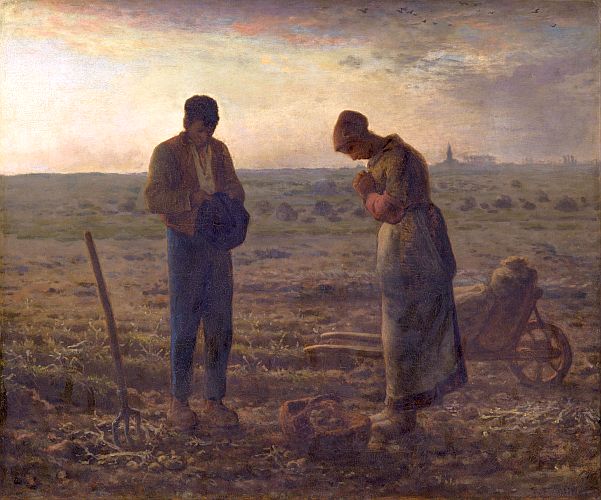
Yesterday, praying the Angelus gave me a few insights.
For those of you not familiar, the Angelus is a traditional Catholic prayer celebrating the Incarnation. It is prayed at 6 am, noon and 6 pm. Church bells will often ring extra at these times because they're calling Catholics to prayer.
First I was thinking of the name of the prayer: "Angelus." Angelus is the Latin nominative for "angel" or "the angel" (Latin doesn't use an article). Many prayers and documents in the Church are titled by their first word or few words. In this case, the first few words are: "Angelus Domini nuntiavit Mariæ," literally: "The angel of the Lord announced (declared, etc.) to Mary." (c.f. Luke 1:28,30,35) The prayer is a reminder of the Angel Gabriel coming to announce the incarnation to Mary, but also to all mankind . . . to "us." I find it funny how in English, the name Angelus, if divided to "Angel-us," can be another reminder of what the prayer is about: the "angel" announcing to "us" the news of the Incarnation.
Beyond a mere English play on the Latin name, I was also thinking about the three verses we pray in the first half of the prayer. They are three statements, taken directly from scripture. Each one reveals something particular about Mary.
"The Angel of the Lord declared unto Mary."
Here, we affirm Mary's dignity even before Jesus was in her womb. The angel called her "full of grace" (kecharitomene in the Greek manuscripts). Mary, we affirm, wasn't simply a woman with some grace, she was full of grace. The Church has understood from early on that Mary was holy--so holy, in fact, that eventually the Church understood well enough to dogmatically define that Mary was conceived free of Original Sin (this is the Immaculate Conception). As Jesus is the New Adam, she is the New Eve. Adam and Eve were created without sin, but they fell. Similarly, Jesus and Mary were sinless from the first moment of their conception. All other humans inherit Original Sin from Adam and Eve, but God protected Mary so that she would be an even more fitting vessel to contain Our Lord. Obviously Jesus, being God, also never had any sin. Mary, even before her connection to Jesus, was model servant of God. That was all the more evident in her acceptance of the responsibility to bear God:
"Behold the handmaid of the Lord."
Mary said yes to God. Granted, at first she was confused and wondered how God was going to make her (an engaged, but unmarried woman) the mother of the Son of the Most High [c.f. Ibid. 31-34], but she didn't doubt. She merely stated: "I am God's servant. I'll do whatever He wants." [c.f. Ibid. 38]. We honor Mary for being open to God's will and saying yes. Her yes was that which allowed our Savior a womb in which He could grow, be nourished and a mother from whose flesh He would take His.
"And the Word became Flesh."
Mary's yes was the opening of the gate of salvation. In fact one of her titles is "Gate of Heaven." Mary actually housed God within her womb. She is the ark of the New Covenant. She was already holy, but this makes her even more holy. No other person in all of history had such an intimate relationship with God. Mary is due honor as the particular human vessel through whom Jesus came into the world.
So Mary is due honor both: as a woman born sinless (and remaining sinless), as a woman who says yes to God's plan, and as the woman who actually bore God in her womb.
This event is special. It is worth contemplation. That is why the Church prays it three times a day. The Incarnation is the moment when, God took on the flesh of man, His greatest creation, in order to redeem all of mankind and renew all of creation. Jesus, the God-man (100% God and 100% human in one person), loved us so much that He deigned to lower Himself to the point of becoming one of us and eventually suffering and dying as a sacrifice to buy us back from the punishment which our sins deserve. God's infinite mercy is available to all of us, no matter how badly we have rejected Him--just look at what great lengths He went through to make that mercy available to us! The Angelus is a great reminder of that mercy, that love . . . and it is a great reminder to honor Our Lady, who was so instrumental in that love and mercy being made available to us. She, in turn, encourages us to look to her Son and tells us: "do whatever He tells you." [John 2:5] I encourage you, to deepen your value for Our Lord's Incarnation, to develop a habit of praying the Angelus devoutly.
The text of the prayer has numerous translations from the Latin original into English. Here is the one I pray:
V. The Angel of the Lord declared unto Mary.
R. And she conceived by the Holy Spirit.
Hail Mary, full of grace, the Lord is with you. Blessed are you among women, and blessed is the fruit of your womb, Jesus.
Holy Mary, Mother of God, pray for us sinners, now and at the hour of our death. Amen.
V. Behold the handmaid of the Lord.
R. Be it done unto me according to Thy word.
Hail Mary, full of grace, the Lord is with you. Blessed are you among women, and blessed is the fruit of your womb, Jesus.
Holy Mary, Mother of God, pray for us sinners, now and at the hour of our death. Amen.
V. And the Word became Flesh.
R. And dwelt amongst us.
Hail Mary, full of grace, the Lord is with you. Blessed are you among women, and blessed is the fruit of your womb, Jesus.
Holy Mary, Mother of God, pray for us sinners, now and at the hour of our death. Amen.
V. Pray for us, O holy Mother of God.
R. That we may be made worthy of the promises of Christ.
Let us pray:
Pour forth, we beseech Thee, O Lord, Thy grace into our hearts, that we, to whom the Incarnation of Christ Thy Son was made known by the message of an Angel, may by His Passion and Cross be brought to the glory of His Resurrection. Through the same Christ Our Lord.
Amen.
Here is Gentileschi's depiction of the annunciation--perhaps my favorite (a great piece to use when contemplating this holy event).

Contemplating the Incarnation,
- Casey
Subscribe to:
Posts (Atom)