Friday, October 29, 2010

My Catholic Vote


Being new to Iowa, I didn't have much information about the candidates in the election coming up next Tuesday, so I went online and found their e-mail addresses and sent them all a message. (Well, I sent a message to all the state and federal candidates. I haven't yet found all of my local candidates' addresses.) I have 6 top issues (as every Catholic should) and I vote according to those issues (as every Catholic should). If a candidate stands the wrong way on any of these issues, he automatically stands opposed to the Catholic view of society, so I would not want him in ANY office--even if that office wouldn't end up having anything to do with that issue.

I've received a number of messages back and it has really helped me to know who to vote for. Not only that, but it lets candidates know what issues are important to me and the Church.

Below is a copy of the letter. Feel free to customize it for use with your own candidates. [edit: Looks like I'm not the only one doing this. Check out Aggie Catholics' Open Letter to Politicians.]


Greetings candidates,

My name is Casey Truelove and I am a Catholic voter. I'm interested in voting according to a well-formed Catholic conscience and I want to know where you stand on particular moral issues. I cannot in good conscience vote in any candidate (on ANY level) who doesn't act AND vote according to a good, well-formed conscience.

I recognize that God Himself has designed man to flourish when he acts well and that man separates himself from God when he acts poorly. This is then reflected in society at large. I also recognize that God has revealed much of what is truly good and what is truly poor for man to do--either through Jesus Himself, or through His Catholic Church and Her reflections on the deposit of faith that Jesus left Her (including what she has recorded in the New Testament of the Holy Scriptures), or through what we inherited from the Jewish people and the (Old Testament) Scriptures that they had written down.

Rather than list the many things that man and society can do to flourish, I will simply list a few topics that afflict modern man and prevent him from flourishing, and which I cannot support:
• Denying God in the public square
- Rejecting God as the designer of community
- This often also goes against the First Ammendment, by impeding the "free exercise" of religion.
• Abortion (playing God by taking life--killing babies while they're still developing in the womb)
• Euthanasia (playing God by taking life again--killing old people instead of letting them die through the means that God intends)
• Human Cloning (playing God by artificially manufacturing living things)
• Trying to redefine marriage so that it includes homosexual couples
- Playing God by thinking that we somehow have an ability to redefine what constitutes a marriage
- This includes trying to redefine parenting so that homosexual couples are looked at as being on par with traditional couples for raising children (biological or adopted)
• Embryonic Stem Cell Research
- Playing God by killing a child in the womb to harvest his cells
- Adult Stem Cell Research is fine and has produced many cures (as opposed to the failures of Embryonic SC Research)

You might have noticed that all of these are a serious offense against God Himself. Catholics cannot support any of them in any way.

Where do you stand on these issues? I can only vote for you if you will represent me and my fellow 67 million American Catholics by voting against ALL of these vices. You can have my vote (and my endorsement to other friends) if you will direct our society toward flourishing--which can only happen by following what is truly best for us, by rejecting these (and any other) social vices. To help us in our confusion, God has given us a number of statements on how to act. We should follow what He has revealed to us as truly good (not just what we think is good). Can I vote for you? Are you going to honestly represent me? Please let me know.

God bless you,
Casey Truelove
Norwalk, IA

Tuesday, October 5, 2010

Only One Thing


In
today's Gospel reading (Luke 10:38-42), Jesus tells Martha:
Martha, Martha, you are anxious and worried about many things. There is need of only one thing. Mary has chosen the better part and it will not be taken from her.
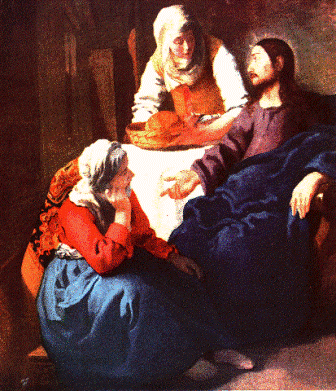
We all know the situation: Jesus comes into town and Martha welcomes Him into her home and starts preparing to serve Him, while her sister, Mary, sits at His feet. Marth gets upset because she's doing all the work to get things ready while Mary just sits with Jesus. Jesus assures her that what Mary is doing (being with Jesus) is much more important than what Martha was doing (worrying about getting everything done). Getting things done has its place, mind you, but if you had Jesus in your house for a short visit, would it be better to spend time with Him, or leave Him in the living room while you make some food?

This got me thinking . . . Jesus is with me for such a short while every day "under my roof." Every day, I have Him right inside my body after receiving Holy Communion at Mass, yet so often my mind, instead of focussing on spending time with my Lord, Who is in my stomach, trails off on thoughts of what needs to get done that day or other worries I have. How sad! I can just hear Jesus lovingly calling me to a better union with Him: "Casey, Casey, you are anxious and worried about many things. There is need of only one thing. Focusing on Me is the better part, and it will not be taken away from you. If you remain faithful to Me, you will be with Me forever."

Trying to focus more on Jesus and less on my worries,
- Casey

Tuesday, September 21, 2010

Marriage: Validity & Indissolubility Revisited

After reading my last posts (part 1 & part 2), a friend asked me about the change involved in a married couple. She wondered if the change was, in fact, ontological. She mentioned that she only remembered an ontological change occurring at Baptism, Confirmation, and Holy Orders. Is the change in Holy Matrimony ontological or is it some other sort of alteration?

That's a good question, I thought. I had assumed that the change in a married couple was ontological, but I hadn't considered it deeply enough. One thing I did know was that there was no indellible character impressed on the souls of the newly married, like there is in Baptism, Confirmation, and Holy Orders. If one has ever received one of those sacraments, one has an unchageable distinction to his/her soul. Nothing can remove the character of Baptism on my soul, nor that of Confirmation--they will be there forever. Marriage, on the other hand, is not an indellible mark because it ends at death.

Granted, there is no character impressed on the soul, but there is a major change: the couple is now bonded to each other, they are a family, they have entered into the covenant, they are also able to properly engage in the marital act (whereas before, it would have been fornication). There is some sort of major change. I cannot help but wonder: is this change ontological, or is it some other sort of alteration, such that the souls of married people are married? Does it depend on whether the marriage is natural or sacramental? I've been looking into finding an answer, but I haven't found anything concrete yet. If anyone has any particular knowledge in this regard, please feel free to share.

Whether the change should be determined as ontological or otherwise, the point I was portraying in those previous two posts still perdures: valid marriage vows bring about a bond between the persons so strong that only death destroys it.

Still searching for an answer,
- Casey

Saturday, September 4, 2010

Marriage: Validity & Indissolubility (Part 2)


Last entry, I focussed intensely on what it takes for a marriage to be validly entered and gave examples of how my wife, Amanda, and I are able to be confident that we have a valid marriage.


This time, I wish to pursue my real goal behind this endeavor: discussing indissolubility. Last post, I stated:

“When entered into validly, nothing can break a marriage covenant, but death . . . 1) In order for the marriage covenant to truly exist, it must be validly entered [which I established]. 2) Once entered, the marriage covenant between the two people exists until one of them dies.”

. . . for better, for worse, for richer, for poorer, in sickness and in health, ‘till death do we part. We commonly recognize these (or similar) words as the vows of those entering into marriage. My wife and I used the Catholic standard vows:

I, Casey, take you, Amanda, to be my wife. I promise to be true to you in good times and in bad, in sickness and in health. I will love you and honor you all the days of my life.

. . . but it’s the same vow because it's entering into the same covenant. Have you ever stopped to think about what this really means? Let’s reflect for a minute.


Entering into the covenant of marriage is a great responsibility, which one professes before God, one’s spouse, and one's community. When we say we “are married,” my wife and I recognize that this is so on multiple levels:

  1. First, the government thinks we’re married. The State of Michigan validated our marriage license application and it was signed by the priest, so, according to the state, we’re officially married: we have a legal bond with each other. This is, more or less, a formality and not really the major goal of what she and I were after.
  2. Second, the Church thinks that we were married. As far as She is able, Holy Mother Church, from Her exterior view (and from the recommendation of the priest on our interior dispositions) thinks we are married. The Church thinks so highly of marriage that She assumes that all marriages are valid unless proven otherwise. [Who wouldn’t think a couple is married? They went through the ceremony; they said: “I do.” If those are your thoughts, please refer back to my previous post about validity for a few ideas about what would make a marriage invalid, even though the couple went through a ceremony.]
  3. Finally, and most importantly, God thinks we’re married--in fact, God knows that we’re married. Moreover, He’s the One Who designed real marriage and allowed Amanda and I the opportunity to give ourselves to each other (such that we are married) to begin with. We are married not only in our thoughts, in the thoughts of our friends and families, in the eyes of the state, or even just in the eyes of the Church, but we’re married IN REALITY. Not only is there the legal bond between us, of which the state is in charge, but a REAL bond exists between us. This is what Catholics mean when we refer to a couple as being married "in the eyes of God."
Two bonds have come about from this union. The first (imparted by the state) is legal and pertains to legal things. The second (imparted by God Himself) is real and pertains to reality itself. If both spouses are baptized Christians, a real marriage also contains a sacramental bond, which pertains to grace (fuller participation in God's Life). This real bond is the real marriage; the legal bond is called marriage, but it's really just the state's signal that it thinks we're married.

Indissolubility
This real bond between Amanda and I is that for which we vowed. We recognize that nothing can break this bond (not the state, not us, not anyone else). We have been joined by God Himself and “what God has joined, no man can separate” (c.f. Matthew 19:6). We fully recognize that, no matter what happens, we are called to love and honor each other for the rest of our lives. Honoring our vows is a HUGE responsibility. Let’s say, God forbid, something really bad happens to us. No matter what, we still honor those vows. Let me discuss some extreme examples:

  1. Major Injury/Disease - Let's say that Amanda were to get into a huge car accident (or developed some majorly debilitating disease) and she was comatose, barely alive and the doctors thought that for the rest of her life, she would be non-responsive. She has a normal life expectancy of at least another 50-60 years. This would mean that probably for the rest of my life, I would no longer have her conscious company and I would not be free to enter into any other relationship. I would still be married to her as long as we are both still living. This would be a great cross to carry for the rest of my life, but that is the vow I made before God and that is the vow I will honor as long as we both shall live. I will live out my role as her husband and pray for her soul that she may be spared the punishment that any sins she may have committed would have earned her. I would offer her soul to God and I would live a life (however lonely) by her side as long as I still breathe. God-willing, one day we will both be glorifying God together in Heaven (though, at that point we would no longer be married--c.f. Matthew 22:30). That would be the truly loving way to live out the vow.
  2. Mental Disease - What if Amanda developed some form of mental disorder whereby she either didn't recognize me and was afraid of me or (worse) hated me? Even in this state, I would be called to love her. Even if she were to run/move away, I would be called to love her as my wife, even though she no longer recognized our relationship. I must still recognize our marriage, pray for her return to sanity and her return to me. That may or may not ever happen, but that would be my calling. That is the only way to live out the vow: for better, for worse, 'till death. That would be the proper way to love her.
  3. Danger - What if that mental disease caused Amanda to become extremely violent to me and/or any children we may one day have? In this situation, I would be called to love her from a safe distance as long as the real threat of violence perdured. Temporary separation, for one reason or another is allowable. In this instance, it would be justified to have her committed or at least for me (and the kids) to move out during this time. We would still be married, but I would have to love her remotely for both of our sakes and/or any children's sakes. I would pray for her to return to sanity and hopefully she would be led there. The fidelity through such fear and strife is the way to truly love her and live out the vow.
  4. Infidelity - This would never happen, but for the sake of illustrating the worst case scenario, allow me to push the envelope. What if Amanda were to be unfaithful to me? Worse, what if this were not an isolated incident: what if she were to run away with another man? She would obviously not be living out her end of the vow, but what would be my responsibility in that instance? I would be called to remain faithful. No matter how unfaithful she might be, I am called to live out my vow. I would be called to pray for her soul, for her conversion, for her return. It may or may not ever happen, but as long as we both should live, we would both be married and I would be called to act as her husband. Even if it has been 20 or 30 years since I had last heard from her, I would still be her husband. Again, it would be an arduously long and lonely road down which I must carry that cross, but I signed up for fidelity through thick or thin. I would still love her and all those years of bearing my burden of loneliness would be my sacrifice for her and for God. That would be my duty. That sacrifice (united to that of Jesus' sacrifice on the Cross) might be what ultimately saves her soul. That would be the way of true love.
  5. Forced Separation - I don't know how this would happen, but let's just say that the US was invaded by some foreign country--for humor and proximity, let's use the Canadians. So, the Canadian army sweeps down into America and has a big problem with the Church (let's face it, Canada's government hasn't been to kind to her lately), so they start deporting all Catholic bishops, priests, deacons and teachers and separating them from their families. Even if I were taken into a Canadian concentration camp for the rest of my life, Amanda would be called to remain faithful to me (and I to her). This scenario would leave us both lonely and longing for each other. We would pray and work toward our reunion, and if God allowed it to be, it would be wonderful, but as long as we haven't heard otherwise, we would assume that the other still lives and would live up to our vows. This would be how to truly love each other in that setting.
In each of these scenarios I would be, in some way, left alone, but still married. Even if I were to meet other women, I would be able to have common friendships with them, but never would it be licit for me to even entertain thoughts of relationships with them, for that would be adultery in my heart (c.f. Matthew 5:28). No flirting, no dating, I would have no romantic companionship unless God allowed a change in the situation whereby Amanda could reunite. I would be a lonely married man, but I would still be a married man. The status of our "being married" will never change until one of us dies. My vow is to God, to her, and to our family, no matter how well or how poorly things are going, I must remain faithful (and so must she).

"What about a divorce?" one might ask. In our society of no-fault divorce (more or less on demand), there could easily be a situation whereby spouse #1 is living out the marriage vow while spouse #2 is not, and eventually #2 files for a divorce and receives it. What has happened? How does spouse #1 live this out? If we have a proper understanding of the two bonds in a marriage, we can understand what has happened in the divorce: the state no longer thinks that the couple is married. Does that mean that they're not really married? No. It means that the legal bond has been broken, but the real bond still exists. Does this free the spouses to marry? No, it doesn't. Although the state might consider them legally free to marry other persons, they are still, in reality, bound to each other. The state didn't create marriage and has no real say over what marriage actually is. No matter how hard they try, they will never be able to achieve a different real marriage bond unless the previous spouse has died. Divorce has no effect on the real bond. Knowing that Amanda and I are definitely married, we are comforted by the surety of knowing that nothing can ever take us apart, not even us.

Didn't Jesus say that divorce was okay in certain situations? No, He didn't. He said:
"For your hardness of heart Moses allowed you to divorce your wives, but from the beginning it was not so. And I say to you: whoever divorces his wife, except for [porneia], and marries another, commits adultery." [Matthew 19:8-9]
What is this porneia? Is it some sort of exception? Some translate it as "unchastity," "adultery," "concubinage," or "immorality," but none of these really gets the idea of the Greek term porneia. The basic idea of porneia is that it is a situation so perverted that no real marriage could have existed in the first place. These would be relationships that are incestuous, homosexual, etc. In today's reading from Paul's first letter to the Corinthians (5:1-8), he also uses the word porneia. Paul is describing a situation where a man is living with his father's wife. Whether this is his mom or his step-mom, this man is in an incestuous or (at least) quasi-incestuous relationship with a woman who is already married to someone else. Their relationship is obviously not able to be a marriage. Because they are living as thought they are married, that relationship is described as porneia.

A relationship described as porneia would have been one which could never be a valid marriage in the first place. In such cases there is no divorce on the level of reality. There may be a legal divorce to make sure that no legal bond exists between the two, but such a divorce would have no effect on their reality because no real bond ever existed. "What therefore, God has put together . . . " [i.e. when there actually is a real bond] "let not man put asunder" (Matthew 19:6). Not even a divorce can change the real bond of marriage.

What about annulments; aren't they just Catholic divorces? No, an annulment is a statement that the marriage in question was never (at any point) valid. There never was a real bond between the couple. There are many ways in which one might go through a marriage ceremony, but not enter into a valid marriage (i.e. things brought up in my previous post). If someone believes he/she might have been invalidly married, they would bring it to the attention of the marriage tribunal of their local Catholic diocese. This tribunal will spend a great deal of time researching and collecting all the possible data they can on that marriage: interviewing, collecting records, etc. Throughout this entire time, the marriage is presumed to be valid. Through an exhaustive process, the tribunal comes to a decision whether the Church still thinks the marriage is valid. Perhaps there was a secret previous marriage that one partner was concealing; perhaps it was shotgun wedding and the people weren't really able to give their consent to the union; perhaps there was a lack of form; perhaps they were 1st cousins; perhaps there was something else that prevented the couple from entering into a real bond (even if they had been living in what they thought was a marriage for many years). In such cases, the tribunal would make a declaration of nullity (an "annulment"), stating that no real marriage ever actually existed. If an annulment is declared, then the couple is able to know for sure that they are not bound to each other, and that they are free to marry other persons.

Such is the case for my parents. They were married for many years and eventually divorced. Eventually my mom was interested in the possibility of getting married to someone else. Knowing that the Church still believed that she was married to my dad, she brought the case to the tribunal. After a long deliberation, the Church found that there was enough evidence to prove that my parents were only legally married all those years and that no real bond existed between them. Now, if my mom were to meet a good Catholic guy, she knows that she would be free to pursue a relationship with him. Whereas before the declaration of nullity, she would have to presume that her marriage with my dad was valid--all marriages are presumed valid unless proven otherwise. She knows that there is no real bond that unites her to my dad. This might also help to explain why they divorced in the first place--they had no backing: no real bond means no graces from marriage as a sacrament. With no sacramental graces and no real bond, it is much harder to live with each other and remain a solidly married couple.

Indissolubility
Through all of this, the real bond is never broken (if it ever comes into existence, it always remains, until one of them dies). If a couple prepares well for the sacrament of marriage, they can be confident that they have a valid marriage. Amanda and I have such confidence. We know that nothing can take us apart. We know that we will be true to each other through good times and bad, and that no matter how tough things get, we have given ourselves to each other, God has bound us together and we are a family--nothing can change that. This mutual knowledge and respect for our vows, for God and for each other, creates an environment of trust between us. Knowing Amanda's great love for God and knowledge of the covenant into which we have entered, I can rest assured that Amanda won't simply take off tomorrow (or some day down the road). I know that she and I will live out our vows to the best of our ability because we both know full and well just what it is to which we have vowed ourselves--and we are backed up by extra graces because our marriage is not only real, but because we are Christians, it is a sacrament--it instrumentally causes us to have a greater participation in God's Life.

Praise God for marriage! Praise God for His Church and Her sacraments! Praise God for Amanda, who is such an amazing woman! Praise God for our preparation prior to marriage! Finally, praise God for our love and our marriage!

Continuing in love,
- Casey

Sunday, August 15, 2010

Marriage Validity & Indissolubility (Part 1)


Two weeks ago, I entered into the covenant of marriage with my (now) wife, Amanda--praise God! Reflecting back, I can see God's hand in my preparation--particularly in this last year, taking multiple classes that focussed on marriage for my degree (Christian Marriage, Liturgy & Sacraments, and Body, Soul & Christianity). We received good proximate preparation for marriage through our marriage prep classes. We also spent time with families who have been together through thick and thin and have gleaned some wisdom from them. One thing that has stuck out to me through all of this is the permanence (indissolubility) of marriage.

When entered into validly, nothing can break a marriage covenant, but death. Stop for a minute and ponder that sentence: When entered into validly, nothing can break a marriage covenant, but death. In order to appreciate its full meaning, there are two big concepts that we must take from that sentence. 1) In order for the marriage covenant to truly exist, it must be validly entered. 2) Once entered, the marriage covenant between the two people exists until one of them dies (yes, if both of them die at exactly the same instant, the marriage is obviously also over). It can be neither broken, revoked, nor mutually dissolved. It is indissoluble.


Entering into a valid marriage.

In order for the marriage to truly exist, it must be validly entered. There are a number of things that are required for a valid marriage, the most basic of them being:
  • 1 man (and only 1 man) who is not otherwise impeded from marrying
  • 1 woman (and only 1 woman) who is not otherwise impeded from marrying
  • Their basic knowledge of what a marriage is (including, but not limited to: lifelong fidelity, openness to children--even if none may come--and a willingness to raise/educate any children with which they are blessed)
  • Their consent to living as a married couple until at least one of them is dead.
Christians have a particular advantage in that their marriages can be sacramental (that is, a marriage may be an instrumental cause of grace--God's life in us--a Christian marriage is something that causes a greater participation in that which God is and which He wants to share with us). In order to do that, both the bride and groom must be baptized persons. Baptism is the first sacrament and it opens the doors to all the other sacraments. Without baptism, one is neither deputed to give nor to receive the sacrament of marriage (the spouses actually confer the sacrament on each other).

Because this is so important (not only for the spiritual lives of the couples, but for the building of society--since marriage is the building block of society) the Catholic Church requires certain things of Catholics who wish to get married. Just as the state, which has certain age, relational and other requirements for its citizens to get married, so too does the Church for those people who are Her citizens. If a Catholic wishes to get married (even if he/she is wishing to marry a non-Catholic), the marriage ceremony must be held within a Catholic church and be witnessed by a Catholic clergyman (deacon, priest, bishop, cardinal, or pope). There are other requirements, but most of them deal with things that the state requires (being old enough, not related, not already married, etc.)--for a better listing of these, see the Code of Canon Law 1083-1129.

As Catholics, Amanda and I had both studied marriage, and we were both ready to accept the roles into which we were stepping--we (praise God) had a more than basic knowledge of what marriage really is. I was a man who was free to marry; she was a woman was free to marry, and we both consented to living out the rights, joys, and responsibilities of marriage with each other as long as we both shall live. This was done in a Catholic ceremony, in a Catholic church, officiated by a Catholic priest, with Catholic witnesses (the priest & witnesses were also very strong, faithful Catholics to boot--not necessary for validity, but helpful for practical purposes). We know that the sacrament into which we entered was completely valid.

Why do I make such a big deal about all the details and the validity of the marriage? I do so because this knowledge (and surety) of the real bond is actually a big deal. There has been a definite change within each Amanda and me, whereby we now are married. It's not just that we call it a marriage, or that it looks like a marriage, or even that the state considers it a marriage. It is all of these things and more. It is a marriage. We have not just the state-recognized legal bond, but we have the real bond of marriage--the bond by which God unites a man and woman, the bond that really creates a family, the bond which God designed for man "in the beginning" (Cf. Matthew 19:4,8; Genesis 2:21-24).

Out of love, God gave us the Catholic Church and marriage, and He has given the Church the inspiration and authority to define what is necessary to make a marriage valid. The Church has many documents on the roles of spouses and of parents. A good summary of these teachings (and part of our required study for marriage prep) is the Catechism of the Catholic Church's section on marriage (paragraphs 1601-1666). By reading what the Church teaches about marriage, we knew what was required of spouses. We know that we consented to all of the requirements. We know that we consented to give ourselves to each other for the rest of out lives. We know that, in the eyes of God, we are definitely married.

This is both a great blessing and a great responsibility. We are now a family. That family cannot be broken--not by the state, not by other people, not even by us. We remain as one as long as we are both alive and we work together (as each other's path to holiness) to lead each other closer to God, until one day, we let go of each other and give each other back to God. The marriage is indissoluble. In my next post, I hope to delve further into just what indissolubility means in a practical manner. Until then, I will be enjoying this new state, the sacramental graces, and time with my wife.

Loving my wife and our marriage,
- Casey

Friday, June 25, 2010

The Angelus


Yesterday, praying the Angelus gave me a few insights.

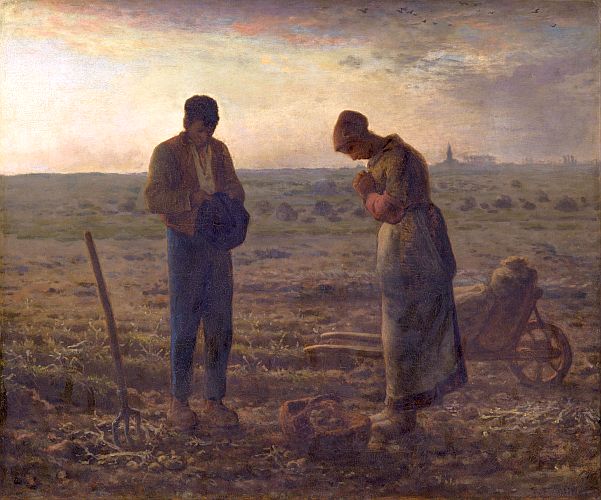
For those of you not familiar, the Angelus is a traditional Catholic prayer celebrating the Incarnation. It is prayed at 6 am, noon and 6 pm. Church bells will often ring extra at these times because they're calling Catholics to prayer.

First I was thinking of the name of the prayer: "Angelus." Angelus is the Latin nominative for "angel" or "the angel" (Latin doesn't use an article). Many prayers and documents in the Church are titled by their first word or few words. In this case, the first few words are: "Angelus Domini nuntiavit MariƦ," literally: "The angel of the Lord announced (declared, etc.) to Mary." (c.f. Luke 1:28,30,35) The prayer is a reminder of the Angel Gabriel coming to announce the incarnation to Mary, but also to all mankind . . . to "us." I find it funny how in English, the name Angelus, if divided to "Angel-us," can be another reminder of what the prayer is about: the "angel" announcing to "us" the news of the Incarnation.

Beyond a mere English play on the Latin name, I was also thinking about the three verses we pray in the first half of the prayer. They are three statements, taken directly from scripture. Each one reveals something particular about Mary.

"The Angel of the Lord declared unto Mary."
Here, we affirm Mary's dignity even before Jesus was in her womb. The angel called her "full of grace" (kecharitomene in the Greek manuscripts). Mary, we affirm, wasn't simply a woman with some grace, she was full of grace. The Church has understood from early on that Mary was holy--so holy, in fact, that eventually the Church understood well enough to dogmatically define that Mary was conceived free of Original Sin (this is the Immaculate Conception). As Jesus is the New Adam, she is the New Eve. Adam and Eve were created without sin, but they fell. Similarly, Jesus and Mary were sinless from the first moment of their conception. All other humans inherit Original Sin from Adam and Eve, but God protected Mary so that she would be an even more fitting vessel to contain Our Lord. Obviously Jesus, being God, also never had any sin. Mary, even before her connection to Jesus, was model servant of God. That was all the more evident in her acceptance of the responsibility to bear God:

"Behold the handmaid of the Lord."
Mary said yes to God. Granted, at first she was confused and wondered how God was going to make her (an engaged, but unmarried woman) the mother of the Son of the Most High [c.f. Ibid. 31-34], but she didn't doubt. She merely stated: "I am God's servant. I'll do whatever He wants." [c.f. Ibid. 38]. We honor Mary for being open to God's will and saying yes. Her yes was that which allowed our Savior a womb in which He could grow, be nourished and a mother from whose flesh He would take His.

"And the Word became Flesh."
Mary's yes was the opening of the gate of salvation. In fact one of her titles is "Gate of Heaven." Mary actually housed God within her womb. She is the ark of the New Covenant. She was already holy, but this makes her even more holy. No other person in all of history had such an intimate relationship with God. Mary is due honor as the particular human vessel through whom Jesus came into the world.

So Mary is due honor both: as a woman born sinless (and remaining sinless), as a woman who says yes to God's plan, and as the woman who actually bore God in her womb.

This event is special. It is worth contemplation. That is why the Church prays it three times a day. The Incarnation is the moment when, God took on the flesh of man, His greatest creation, in order to redeem all of mankind and renew all of creation. Jesus, the God-man (100% God and 100% human in one person), loved us so much that He deigned to lower Himself to the point of becoming one of us and eventually suffering and dying as a sacrifice to buy us back from the punishment which our sins deserve. God's infinite mercy is available to all of us, no matter how badly we have rejected Him--just look at what great lengths He went through to make that mercy available to us! The Angelus is a great reminder of that mercy, that love . . . and it is a great reminder to honor Our Lady, who was so instrumental in that love and mercy being made available to us. She, in turn, encourages us to look to her Son and tells us: "do whatever He tells you." [John 2:5] I encourage you, to deepen your value for Our Lord's Incarnation, to develop a habit of praying the Angelus devoutly.


The text of the prayer has numerous translations from the Latin original into English. Here is the one I pray:

V. The Angel of the Lord declared unto Mary.
R. And she conceived by the Holy Spirit.

Hail Mary, full of grace, the Lord is with you. Blessed are you among women, and blessed is the fruit of your womb, Jesus.
Holy Mary, Mother of God, pray for us sinners, now and at the hour of our death. Amen.

V. Behold the handmaid of the Lord.
R. Be it done unto me according to Thy word.

Hail Mary, full of grace, the Lord is with you. Blessed are you among women, and blessed is the fruit of your womb, Jesus.
Holy Mary, Mother of God, pray for us sinners, now and at the hour of our death. Amen.

V. And the Word became Flesh.
R. And dwelt amongst us.

Hail Mary, full of grace, the Lord is with you. Blessed are you among women, and blessed is the fruit of your womb, Jesus.
Holy Mary, Mother of God, pray for us sinners, now and at the hour of our death. Amen.

V. Pray for us, O holy Mother of God.
R. That we may be made worthy of the promises of Christ.

Let us pray:

Pour forth, we beseech Thee, O Lord, Thy grace into our hearts, that we, to whom the Incarnation of Christ Thy Son was made known by the message of an Angel, may by His Passion and Cross be brought to the glory of His Resurrection. Through the same Christ Our Lord.

Amen.

Here is Gentileschi's depiction of the annunciation--perhaps my favorite (a great piece to use when contemplating this holy event).


Contemplating the Incarnation,
- Casey

Saturday, June 19, 2010

All These Things Will Be Given You

" . . . all these things will be given you . . ." So often, we have the tendency to look at this part of yesterday's Gospel reading as though Jesus is saying "I'm going make your life cushy and easy; just let me give you everything." This is particularly prevalent in the "Health & Wealth" preachers ("believe in Jesus and you'll be cured of your sicknesses and become independently wealthy"). We too often, however, forget to read (and understand) the first half of the sentence: "seek first the Kingdom of God and His righteousness."

Yes, God wants us to trust Him and His providence for our lives, but He also wants us to be seeking Him and His righteousness, drawing ever closer to Him and living in a righteous manner. Augustine comments on this:

The kingdom of God and His righteousness is our good which we ought to make our end. But since in order to attain this end we are militant in this life, which may not be lived without supply of these necessaries, He promises, "These things shall be added unto you." That He says, "first," implies that these are to be sought second not in time, but in value; the one is our good, the other necessary to us. For example, we ought not to preach so that we may eat, for so we should hold the Gospel as of less value than our food; but we should therefore eat so that we may preach the Gospel. But if we "seek first the kingdom of God and his righteousness," that is, set this before all other things, and seek other things for the sake of this, we ought not to be anxious lest we should lack necessaries; and therefore He says, "All these things shall be added unto you;" that is, of course, without being a hindrance to you: that you may not in seeking them be turned away from the other, and thus set two ends before you.
- Golden Chain 3624


The Kingdom of God and His righteousness are our goal and ultimate end. Yet, while we are on this earth, we need things of this earth to survive (i.e. food, clothing, shelter, etc.). In this passage Jesus is encouraging us not to get too focused on those things. We are supposed to be focussed primarily on the Kingdom and on living virtuously (righteously, persevering in charity despite the great temptations toward uncharitable action). We are not to worry about our bodily needs (but we are also not to ignore them). We are to be focussed on living righteously so that we may one day hear those great words: "Welcome into the kingdom, my beloved servant." What we need to worry about is: "Am I living my whole life the way God wants me to live? Does God approve of the motivations, intentions, and execution of my actions? Do I live in a manner that comports with the truth, with reality, with the way God designed people to live in this universe?"

Catholic Ads

Pages