Wednesday, March 2, 2011

The Role of Catholic Parents

Back on February 8th, I gave a talk to the parents of students who were preparing to receive 1st Communion or Confirmation. The first part of the talk was just about the requirements that our specific parish has for kids to receive the sacraments. The second part of the talk, was about the role of Catholic parents. Below is a recording of the second part of the talk.

We also gave the parents a handout with a bunch of quotes so that they could follow along. The text of the handout is below the video:


Holy Communion & Confirmation: The Beginnings of Life in the Church
“He who eats my flesh and drinks my blood abides in me and I in him.” John 6:56
“On that day you will know that I am in my Father, and you in me, and I in you.” John 14:20
“Abide in me, and I in you. As the branch cannot bear fruit by itself, unless it abides in the vine, neither can you, unless you abide in me. I am the vine, you are the branches. He who abides in me, and I in him, he it is that bears much fruit, for apart from me you can do nothing. If a man does not abide in me, he is cast forth as a branch and withers; and the branches are gathered, thrown into the fire and burned. If you abide in me, and my words abide in you, ask whatever you will, and it shall be done for you.” John 15:1-4
“I have been crucified with Christ; it is no longer I who live, but Christ who lives in me; and the life I now live in the flesh I live by faith in the Son of God, who loved me and gave himself for me.” Gal. 2:20
Precepts of the Church
--"meant to guarantee to the faithful the very necessary minimum in the spirit of prayer and moral effort, in the growth in love of God and neighbor." [CCC 2041]

I. Attend Mass on Sundays and Holy Days of Obligation (even if you cannot receive Holy Communion) and rest from servile labor on those days--keep them holy.
  1.   Show your children (by your behavior) that Mass is VERY important.
    1. Respect for the Nave (not a social hall)
    2. Our demeanor changes to show how holiness of this space.
    3. Stop all socializing when entering the church
    4. Focus on God/prayer
    5. Fast before receiving Communion--Eat nothing (except water and medicine as needed) for an hour before receiving Holy Communion--shows respect for our Lord.
    6. Learn about how Mass is a sacrifice, offered by the priest, and how we unite with that sacrifice with our minds (during the offering) and bodies (in Holy Communion)--this is what Mass is about.
    II. Go to Confession at least once/year


    III. Receive Holy Communion at least once during the Easter Season.


    IV. Observe the days of fasting and abstinence established by the Church.
    1. Prepares us for feasts
    2. Helps us acquire mastery over our instincts and freedom of heart.
    3. Fasting - eating less than two full meals in one day (Ash Wednesday & Good Friday)
      1. All Catholics 18-59
      2. No eating between meals
      3. Regular liquids are fine
    4. Abstinence - not eating the meat of warm blooded animals (beef, pork, chicken, turkey, etc.--fish and other cold-blooded animals may be eaten).
      1. All Catholics 14+
      2. Every Friday of the year
      3. In the US, outside of Lent, we can substitute some other comparable penance instead of abstaining, but we still must perform SOME penance.
    V. Help to provide for the material needs of the Church.
    1. Each according to his ability
      1. “And all who believed were together and had all things in common; and they sold their possessions and goods and distributed them to all, as any had need. And day by day, attending the temple together and breaking bread in their homes, they partook of food with glad and generous hearts, praising God and having favor with all the people. And the Lord added to their number day by day those who were being saved.” (Acts 2:44-47)
      2. “He sat down opposite the treasury and observed how the crowd put money into the treasury. Many rich people put in large sums. A poor widow also came and put in two small coins worth a few cents. Calling his disciples to himself, he said to them, “Amen, I say to you, this poor widow put in more than all the other contributors to the treasury. For they have all contributed from their surplus wealth, but she, from her poverty, has contributed all she had, her whole livelihood.” (Mark 12:41-44)
      3. Tithing (giving 10% of your income to the Church)
        1.  Jacob to God: “Of all that You give me I will give the tenth to You.” (Genesis 28:22)
        2. "All the tithe of the land, whether of the seed of the land or of the fruit of the trees, is the LORD's; it is holy to the LORD. If a man wishes to redeem any of his tithe, he shall add a fifth to it. And all the tithe of herds and flocks, every tenth animal of all that pass under the herdsman's staff, shall be holy to the LORD.” (Leviticus 27:30-32)
        3. "You shall tithe all the yield of your seed, which comes forth from the field year by year . . . And if the journey to the priest is too far to carry seed . . . then you shall turn the seed into money” (cf. Deuteronomy  14:22-25)
        4. “As soon as the command was spread abroad, the people of Israel gave in abundance the first fruits of grain, wine, oil, honey, and of all the produce of the field; and they brought in abundantly the tithe of everything. And the people of Israel and Judah who lived in the cities of Judah also brought in the tithe of cattle and sheep, and the dedicated things which had been consecrated to the LORD their God, and laid them in heaps.” (2 Chronicles 31:5-6)
        5. “Then all Judah brought the tithe of the grain, wine, and oil into the storehouses.” (Nehemiah 13:2)
        6. “Will man rob God? Yet you are robbing me. But you say, `How are we robbing thee?' In your tithes and offerings. You are cursed with a curse, for you are robbing me; the whole nation of you. Bring the full tithes into the storehouse, that there may be food in my house; and thereby put me to the test, says the LORD of hosts, if I will not open the windows of heaven for you and pour down for you an overflowing blessing.” (Malachi 3:8-10)
        7. “With every gift show a cheerful face, and dedicate your tithe with gladness.” (Sirach 35:9)
        8. Offering your time to help out with Church events/projects
        9. Ask yourself:
          1. “What does the Church need?”
          2. “What gifts/talents has the Lord given me to build up the Church?”
        Parents’ Roles in the Education of Their Children
        “Since parents have given children their life, they are bound by the most serious obligation to educate their offspring and therefore must be recognized as the primary and principal educators. This role in education is so important that only with difficulty can it be supplied where it is lacking. Parents are the ones who must create a family atmosphere animated by love and respect for God and man, in which the well-rounded personal and social education of children is fostered. Hence the family is the first school of the social virtues that every society needs. It is particularly in the Christian family, enriched by the grace and office of the sacrament of matrimony, that children should be taught from their early years to have a knowledge of God according to the faith received in Baptism, to worship Him, and to love their neighbor. Here, too, they find their first experience of a wholesome human society and of the Church. Finally, it is through the family that they are gradually led to a companionship with their fellowmen and with the people of God. Let parents, then, recognize the inestimable importance a truly Christian family has for the life and progress of God's own people.” (Declaration on Christian Education 3)
        “All members of the family, each according to his or her own gift, have the grace and responsibility of building, day by day, the communion of persons, making the family "a school of deeper humanity": this happens where there is care and love for the little ones, the sick, the aged; where there is mutual service every day; when there is a sharing of goods, of joys and of sorrows.
        A fundamental opportunity for building such a communion is constituted by the educational exchange between parents and children, in which each gives and receives. By means of love, respect and obedience towards their parents, children offer their specific and irreplaceable contribution to the construction of an authentically human and Christian family. They will be aided in this if parents exercise their unrenounceable authority as a true and proper "ministry," that is, as a service to the human and Christian well-being of their children, and in particular as a service aimed at helping them acquire a truly responsible freedom, and if parents maintain a living awareness of the "gift" they continually receive from their children.
        Family communion can only be preserved and perfected through a great spirit of sacrifice. It requires, in fact, a ready and generous openness of each and all to understanding, to forbearance, to pardon, to reconciliation. There is no family that does not know how selfishness, discord, tension and conflict violently attack and at times mortally wound its own communion: hence there arise the many and varied forms of division in family life. But, at the same time, every family is called by the God of peace to have the joyous and renewing experience of "reconciliation," that is, communion reestablished, unity restored. In particular, participation in the sacrament of Reconciliation and in the banquet of the one Body of Christ offers to the Christian family the grace and the responsibility of overcoming every division and of moving towards the fullness of communion willed by God, responding in this way to the ardent desire of the Lord: ‘that they may be one.’” (Familiaris Consortio 21)
         
        [UPDATE - Below is the Examination of Conscience that I handed out.]

        Examination of Conscience

        Below is a list of questions about sin.

        It is not exhaustive, but it will help you examine your conscience.


        1. You shall have no other gods besides the Lord your God.

        • Do I love God with my whole life, above all things?

        • Is He number one in my life or do I put myself before God?

        • Has money and/or pleasure become more important to me than God?

        • Do I pray every day, even when I don’t want to?

        • Have I read or listened to a bit of the Bible every day?

        • Have I neglected my friendship with God by neglecting prayer?

        • Have I been involved with occult or superstitious practices, i.e., good luck charms, fortune telling, Ouija boards, horoscopes, tarot cards, séances, channeling, astrology, etc.?

        • Have I been involved in the New Age, Yoga, Taoism, Buddhism, Hinduism, or any other Eastern philoso-phies/theologies?

        • Have I been involved in any other false or pagan worship?

        • Have I ever received Holy Communion in the state of mortal sin?

        • Have I told a lie in confession or deliberately withheld confessing a mortal sin?

        • Do I genuflect to the tabernacle when I enter a Catholic church?

        • Am I respectful when other people are praying or have I tried to distract them?

        • Have I told the Father that I love him for creating me and making me his son/daughter?

        • Have I thanked Jesus for becoming man, dying for my sin, and rising to give me eternal life?

        • Have I asked the Holy Spirit to help me conquer sin and temptation and to be obedient to God’s com-mands?

        • Have I been rebellious toward God and his commands?

        • Have I left the Church? (This is the sin of apostasy.)

        • Have I ever rejected any part of the Catholic faith?

        • Have I joined the Masons or another secret society?

        • Have I gotten married by a justice of the peace or another non-Catholic minister (without first getting the bishop’s dispensation)?

        • Have I ever desecrated the Holy Eucharist?

        • Have I ever committed a sin with the excuse that “I can just go to confession to get rid of it”? (This is the sin of presumption—sinning because you are presuming on God’s mercy—basically taking advantage of the Mercy that God offers you.)


        2. You shall not take the Lord your God's name in vain.

        • Have I ever lied after "swearing to God" that I am telling the truth?

             o Have I ever committed perjury (lied under oath in a court of law)?

        • Have I ever used God's name out of anger, as a curse?

        • Have I ever used any other curse words?

        • Do I always try to show respect to God during prayers, in the church, and when I use His name?

        • Do I say “Oh my goodness!” (or something else) instead of taking God’s name in vain by saying “Oh my God!”

        • Do I ever say “Jesus” and/or “Christ” in a way that does not honor God?


        3. Keep the Sabbath day holy.

        • Have I deliberately missed Holy Mass on the Christian Sabbath (Saturday evening through Sunday)?

        • Have I ever missed Mass on a Holy Day of Obligation?
             o January 1- Mary, Mother of God (unless it’s on a Saturday or Monday)
              Ascension Thursday is moved to Sunday in this diocese
             o August 15 - Assumption of Mary (unless it’s on a Saturday or Monday)
             o November 1 - All Saints (unless it’s on a Saturday or Monday)
              December 8 - the Immaculate Conception of Mary
              December 25 - the Nativity of Our Lord Jesus Christ (Christmas)

        • Have I willingly gone to Mass on Sunday, or have I rebelled and been stubborn about going to Mass?

        • Did I participate in the Mass (consciously unite myself to the sacrifice) or did I daydream?

        • Am I quiet when I am in the church, especially before, during, and after Mass?

        • Did I try to honor God in a special way on every Sunday and Holy Day by going to Mass and making the day special?

        • Do I try to rest on Sundays and Holy Days and avoid doing physical labor?


        4. Honor your father and your mother so that you may live long and flourish.

        For Children:

        • Do I obey my parents?

        • Do I always speak with respect to my parents, never yelling at them nor speaking unkindly to them?
             o Do I swear at them?
             o Do I lie to them?
             o Do I talk back rudely to them?
             o Do I steal from them?
             o Am I ashamed of them?
             o Do I let them know I love them?
        • Do I help my parents around the house without being asked?
             o Do I respond the first time when my parents ask me to do something?
        • Have I tried to follow rules/laws in my home, classroom, state, country, etc.?
        • Do I obey and honor those in place of my parents, such as teachers and principals?
             o Do I skip class?
             o Do I lie to my teachers?
             o Do I talk disrespectfully to my teachers?
             o Do I swear at them or talk back rudely to them?
             o Do I work as hard as I should on my lessons?
             o Do I try my best on my schoolwork?

        For Parents:

        • Do I abuse or neglect my children?

        • Have I failed to baptize my children within a few months after their births?

        • Have I neglected to teach my children the Catholic faith?

        • Have I failed to live out the Catholic lifestyle so as to pass the faith on to my kids?

        • Have I neglected to learn the Catholic faith to the best of my ability so that I can better pass it on to my kids?


        5. You shall not kill.

        • Have I murdered anyone?

        • Am I killing myself by taking illegal drugs, such as marijuana, cocaine, heroine, etc.?

        • Am I killing myself by abusing alcohol?
             o If I’m not old enough to legally drink, have I abstained from drinking?
             o Have I ever gotten drunk?

        • Have I had an abortion? (“Selective reduction” of babies in the womb from in-vitro fertilization counts as abortion.)

        • Have I ever encouraged anyone to have an abortion?

        • Do I stand up for the unborn child's right to life, or have I merely accepted society's anti-life mentality?

        • Have I knowingly voted for a politician who tolerates abortion (“pro-choice” = “pro-abortion”) when there was a pro-life politician available to vote for?

        • Have I used the birth control pill to avoid pregnancy (which causes abortions if it fails to prevent fertiliza-tion)?
             o Have I encouraged anyone else to use the pill?

        • Have I sterilized myself in any way or encouraged anyone else to do so?

        • Did I participate in or approve of euthanasia or "mercy-killing" of a human being?

        • Have I killed anyone's reputation by deliberately spreading rumors or keeping rumors alive by passing them on?
             o Have I gossiped about others?

        • Do I nurse anger against anyone (hold a grudge, refuse to forgive)?

        • Have I cursed anyone?

        • Have I started a fight with anyone at home, school or elsewhere (defending yourself is okay)?

        • Have I bullied anyone, made fun of them, mocked them, or called them names?

        • Have I tried to get others to do things that are wrong?

        • Have I watched things on TV, in movies, or on the computer that would not be pleasing to God?

        • Have I driven drunk or under the influence of any other substance that is dangerous to mix with driving (even if I didn’t cause any damage)?

        • Have I driven dangerously (even if I didn’t cause any damage)?

        • Have I mutilated myself (cutting, excessive tattoos or body piercing, etc.)?

        • Have I seriously entertained suicidal thoughts?

        • Have I attempted suicide?

        • Have I failed to bury the dead? (“Spreading ashes” is not allowed in the Catholic Church—because it is seen as a denial of the resurrection of the body—the belief that God will raise our bodies and reunite them with our souls at the end of time.)

        • Have I intentionally placed temptation before people who were weak to such temptations?

        • Have I been a bigot (hated people because of their race)?

        • Have I been involved in or supported human cloning?


        6. You shall not commit adultery.

        • Have I ever had sex with anyone (or anything) who is not my spouse?

        • Have I masturbated (sexually stimulated myself)?

        • Have I ever watched, read or listened to pornography either on the Internet or through some other media?

        • Have I ever freely and deliberately entertained impure thoughts, sexual fantasies, etc.?

        • Have I practiced any form of contraception (condom, pill, IUD, spermacide, Onanism, etc.)?

        • Am I modest in dress?
             o Do I cover the parts of me that only my spouse should see?
             o Do I try to gain people’s attention by uncovering parts of my body?

        • Have I looked at others lustfully (desiring to use them for sexual gratification)? (Thinking of giving oneself to one’s spouse in the marital act is good, but desiring to use anyone, even a spouse, simply as a sexual ob-ject is bad.)

        • Have I sexually kissed or touched someone who wasn’t my spouse?

        • Have I participated in in-vitro fertilization, artificial insemination, or surrogate motherhood?

        • Have I been involved in types of fertility testing that involve immoral acts (masturbation, etc.)?

        • Have I willfully divorced or deserted someone to whom I know I was validly married? (If a situation be-comes dangerous, it is permissible for a spouse to separate, but if the marriage was valid, it is a sin to di-vorce.)

        • Have I had multiple spouses at once (polygamy/polyandry)?

        • Have I cohabited (lived together) with someone of the opposite sex who wasn’t my spouse? (It is sinful for engaged couples to live together before they are married.)


        7. You shall not steal.

        • Have I stolen from my parents?

        • Have I stolen from friends?

        • Have I ever stolen from a stranger?

        • Have I stolen anything from a store?

        • In other words, have I ever taken what rightfully belongs to another?

        • Do I respect what other people own by not taking what is not mine?

        • Do I gamble excessively (more than what I could comfortably afford to lose)?

        • Do I seek to share what I have with the poor and needy?

        • Am I honest at school or have I cheated on a test or my homework (stealing someone else’s work)?

        • When I borrow things, do I intend to return all of them? Do I return them?

        • Do I respect people’s possessions, including my own?
             o Do I treat my possessions well?
             o Do I treat others’ things well?
             o Have I done anything bad to another’s property like littering or writing on walls, desks or other things that aren’t mine?

        • Have I stolen computer software, music or any other media? (All media that isn’t freely offered to the pub-lic must be purchased. Otherwise, we’re stealing from the people who produce the media.)

        • Have I padded my expense or per diem account(s)?

        • Have I taken advantage of the poor, simple, inexperienced, or less fortunate?

        • Have I denied help to the poor when I could easily help them?

        • Have I defrauded creditors or cheated on my taxes?

        • Have I bribed anyone or taken a bribe?

        • Have I blackmailed anyone?

        • Have I committed fraud, embezzlement, price fixing, tax evasion, forgery, etc.?

        • Have I excessively wasted anything God has given me (food, money, time, etc.)?


        8. You shall not bear false witness against your neighbor.

        • Am I a liar?

        • Am I guilty of detraction (making known the faults of others without serious reason)?

        • Am I guilty of slander (spreading lies about someone)?

        • Do I gossip about others?

        • Do I reveal information that should be confidential?

        • Am I "two-faced", that is, have I been a certain kind of person to some people, but a completely different kind of person to others?

        • Did I tell the truth, even when it was hard to do so--even when I might have gotten in trouble?

        • Do my words positively affect people?

        • Have I hurt people with lies or by talking about their faults?

        • Have I talked about people behind their backs?

        • Have I hurt people by making fun of them?

        • Have I cheated in work, play, or any other activity?


        9. & 10. You shall not envy your neighbor's wife and goods.

        • Am I envious of others? (Am I sad when good things happen to them or when they do well?)

        • Do I wish that others would be deprived of the goods or talents that are theirs?

        • Am I jealous of others? (Do I wish I had their stuff instead of them?)

        • Am I a resentful person?

        • Do I thank God for what I have or do I wish for what others have?
             o Am I grateful for what I have or do I complain about it?
             o Am I grateful for how much I have or do I ask for more?
             o Am I thankful to our Lord for Confession--the special opportunity to say I am sorry and be for-given?


        Other general sins that could fit into various places above:

        • Have I been selfish or spiteful toward others?

        • Have I been prideful?
             o Have I loved myself too much?
             o Have I not wanted to let go of my hopes in order to allow for what God/others want?
             o Have I been unwilling to admit when I’m wrong?

        • Have I been patient, kind, gentle, and self-controlled?

        • When my conscience told me to do something good, did I do it, or did I ignore it?

        Saturday, February 26, 2011

        M.A. Thesis Presentation

        Below is a video of the presentation of my M.A. thesis: Sacrificial Aspects Of The Eucharist And Marriage.

        Part 1 (10:00)

        Part 2 (10:00)

        Part 3 (4:36)

        Tuesday, February 15, 2011

        Same Mass, New Words

        The Holy Sacrifice of the Mass
        St. Ignatius of Antioch

        Many of you may have heard that the words of the Mass are changing next Advent. This is mostly true. The English translation is being adjusted to be more like the rest of the world. To understand why this is happening, we need to know the Church’s understanding of liturgy. Liturgy is the Catholic Church’s official public worship. St. Ignatius of Antioch is the man who is thought to have coined the term “Catholic” in reference to the Church (or at least his is the oldest surviving written use of the term). Katholicos is the Greek term for "universal." Calling the Church "Catholic" means that it is the same all around the world; it is universal. Faithful Catholics hold to the same beliefs, and if there are any discrepancies, we have the local authority (the bishop) to officially recognize those beliefs which are in line with the Church and reject those beliefs which are not. As St. Ignatius stated in his Letter to the Smyrnaeans (8), "Wherever the bishop shall appear, there let the multitude [of the people] also be; even as, wherever Jesus Christ is, there is the Catholic Church." They all held the bishop of their area to be the authority for their area, and (for greater unity) the bishop of Rome (the pope) as the head of the Church--the one guy who had the authority to settle all disputes about the faith. Catholics express what they believe in their official public ceremonies--their liturgies. The chief among these liturgies was (and is) the Mass, at which the sacrifice of Jesus on the cross is made present on the altar as the bread and wine become His body and blood. They are offered to the Father by the priest. All the people who have assembled unite themselves to the priest’s offering both in mind (as the priest offers the sacrifice to God) and in body (as they receive Jesus in Holy Communion). This is Catholic worship. This is what Catholics believe, and this is what the words and actions of the liturgy are crafted to express.

        The Roman Missal
        In order to be truly “Catholic” in Her worship, the Church has established instructions on how to celebrate the Mass, and She carefully guards how the liturgy is celebrated, to make sure that the authentic Catholic spirituality is being expressed. The Roman Missal is the official name for the book of how to celebrate the Mass. In it there are many instructions (rubrics) written in red, stating what is supposed to be done and words in bold black for the priest to pray aloud. You’ll see the priest reading from the Missal (sometimes also called the Sacramentary) during the Mass. The Church is so careful about how the Mass is celebrated that any variations need to be approved by the pope’s special liturgy cabinet (The Congregation for Divine Worship and the discipline of the Sacraments). There are certain options that are given to bishops to decide for their dioceses (such as whether people in his diocese will kneel or stand after the Lamb of God) and there are minor options that each priest is allowed to choose (such as which direction to face or which language to use, etc.). Aside from those few options, however, the Church tries to make sure that the liturgy is uniform, so much so that the Second Vatican Council stated: “Therefore no other person, even if he be a priest, may add, remove, or change anything in the Liturgy on his own authority.” (Sacrosanctum Concilium 22.3, reiterated in the General Instructions of the Roman Missal 24)

        The Pope with Bishops who were working on the English Translation.
        The official documents from the Church are all produced in Latin (the official language of the Catholic Church) and then translated into English. The Roman Missal has seen some updates through the years, always trying to more explicitly express our faith. The most recent update to the Missal was in 2000. Since that time the English speaking bishops called for a complete revision of all the texts we use for Mass. They wanted to make sure that what we English speaking people say at Mass is more like what everyone else around the world speaks. They wanted to make it more Catholic. They also wanted to make the words more explicitly state what we believe. In this age where so many Catholics do not know Church teaching well, who can blame them?
        A great effort was made by people across the world to try to make a revised translation that was as accurate to the original Latin as possible and one that more explicitly stated what the Church believes. We Catholics learn much about our faith simply by going to Mass. The reverence and solemnity with which the Mass is offered and the words we hear & say are all designed to draw our minds up, out of ourselves, and focus us on God. This new translation provides an opportunity for all of us to come to understand the Mass better and to focus more on what it is that we are saying--thereby truly participating in the sacrifice with our minds and hearts and enabling us to be drawn even closer to God. We say the same things at Mass each week because they are important, but this repetition can cause us to take it for granted. This new translation will help us to concentrate more on exactly what we believe. This will hopefully help all of us come to a better understanding of God and of our Catholic faith. It will also help us to be more Catholic--that is, more “universal,” more like the rest of the Catholic world in the ideas we express by the words at Mass. The rest of the world already expresses most (if not all) of the words in these more accurate ways.
        How much is changing? Not much. In an average Mass there will be less than 150 new words. To give you an idea of how little that is, it is about twice the size of this paragraph. It is still the same basic structure, just a little tweaking here and there to make the language more accurate. Not much is changing, but it will definitely be noticeable and it will hopefully be very helpful for all of us.
        We will be having multiple opportunities for you to learn about the new translation before it gets implemented next Advent. If you would like a sneak peak, the US bishops have a good web site for information about the translation:

        Friday, January 28, 2011

        Happy St. Thomas Aquinas Day


        In honor of the Angelic Doctor, and in order to lead you to truly having a "happy" St. Thomas Aquinas day, I thought I would post some quotes of his on happiness. He begins by reminding us that we will not find true happiness in any created thing--no matter what next gadget or pleasure we attain, we will always be wanting more (emphasis mine):
        It is impossible for any created good to constitute man's happiness. For happiness is the perfect good, which lulls the appetite altogether; else it would not be the last end, if something yet remained to be desired. Now the object of the will, i.e. of man's appetite, is the universal good; just as the object of the intellect is the universal true. Hence it is evident that naught can lull man's will, save the universal good. This is to be found, not in any creature, but in God alone

        St. Thomas Aquinas, Summa Theologica, I-II Q.2 A.8 body

         As the good doctor stated, our happiness is found in God. Later he notes that happiness consists the contemplation of God:
        Final and perfect happiness can consist in nothing else than the vision of the Divine Essence . . . For perfect happiness the intellect needs to reach the very Essence of the First Cause. And thus it will have its perfection through union with God as with that object, in which alone man's happiness consists.

        Q.3 A.8 body

         To reach the vision of God requires the rectitude of the will:
        Rectitude of will is necessary for Happiness both antecedently and concomitantly. Antecedently, because rectitude of the will consists in being duly ordered to the last end . . . Concomitantly, because as stated above (Question 3, Article 8), final Happiness consists in the vision of the Divine Essence, Which is the very essence of goodness. So that the will of him who sees the Essence of God, of necessity, loves, whatever he loves, in subordination to God; just as the will of him who sees not God's Essence, of necessity, loves whatever he loves, under the common notion of good which he knows. And this is precisely what makes the will right. Wherefore it is evident that Happiness cannot be without a right will.

        Q.4 A.4 body


        We attain that happiness through living virtuously:
        Rectitude of the will, as stated above (Question 4, Article 4), is necessary for Happiness; since it is nothing else than the right order of the will to the last end . . . Man obtains [happiness] by many movements of works which are called merits. Wherefore also according to [Aristotle] (Ethic. i, 9), happiness is the reward of works of virtue.

        Q.5 A.7 body


        In short: live virtuously (do good, avoid evil) in order to purify your will. (N.B.: Living virtuously requires us to ask for and receive God's help--we cannot keep up the life of virtue without grace.) The rectitude of your will will order you to the proper ultimate end (God), and you will love that proper ultimate end. Through your love for the proper end, you will move closer to it and eventually attain the end (union with God, vision of God as He is--eternal contemplation of the infinite Source of all goodness, truth, love, etc.). This is your ultimate happiness. This is what each of us is called to do--this is what we were made for. It is not easy; in fact, it is very challenging--it will take a lifetime of work, but that work will be worth it in the end. Doing that work will also have its own (smaller) rewards. Through living virtuously you will gain the satisfaction that you are doing what you were made to do--you will feel a real sense of fulfillment, not just a cheap high. You will be on your way to true happiness, not just fleeting emotional peaks.
         
        Striving for virtue,
        - Casey

        Saturday, January 15, 2011

        Good God!


        My friend Anthony posted a note on Facebook yesterday, and it quickly garnered a lot of responses. His post was on calling God "good,"and what "good" really means. I decided to add to the growing list of responses:

        Good note Anthony. I haven't been able to read all the comments, but I was wondering if you have considered going further on goodness itself. There has been a lot of use of the word "good" without defining what goodness really is. You were on to something when you noted that being "good" takes discipline. There are many things we would rather do that seem more comfortable, easier, etc., but we know that ultimately they are not good for us. So what makes something good?

        Thomas wrote: "The essence of goodness consists in this, that it is in some way desirable. Hence [Aristotle] says: 'Goodness is what all desire.' . . . a thing is desirable insofar as it is perfect; for all desire their own perfection. But everything is perfect so far as it is actual [no longer potential] . . . good is attributed to God inasmuch as all desired perfections flow from Him as from the first cause." [Summa Theologica I-I Q.5-6]

        To understand this a little better, let's start by saying that when we say that "God is Good." Not only do we affirm that God has a quality of goodness, but that God IS Goodness Itself, and all things that have any goodness to them are only good because they participate in Him [the "first cause" of good]. In what way do they participate in Him? They primarily participate in God on the level of being. They exist only because God is Existence Itself, and He allows other things to exist [to become real, actual]. He also designs all things to have ends--both proximate and final--that is, He designs things to develop over time, to strive for their own perfection (like a rose, striving to be all the rose it can be, from bud, to its peak--even while it withers it is still trying to be that peak rose.) The rose has the proximate end of peak rose. Man has the proximate end of peak man-ness, and the final end of union with God Himself. These ends are the "desires" of which Thomas and Aristotle wrote. Everything not only has an end, but has an inner longing to accomplish that end--to complete that for which it was made.

        In this way, what is truly "good" is that for which we were made--union with God. We are good, physically, as we perfect our bodies to achieve our peak physique, power, health, agility, etc. We are not called to a flash-in-the-pan peak (whereby we have one moment at which we have achieved the highest peak and from that point on, we can only look back on the "glory days"); rather, we are called to a continual striving for perfection throughout our lives--we are moved to remain fit even as we grow old. There are other ways of being "good": intellectually, emotionally, etc., but what is most commonly discussed with regard to goodness is moral goodness. Moral goodness is based on acts that conform or do not conform to that for which we were made--that is, they do not conform to God (Who is Love Itself). That is why the two greatest commandments are to love God and love neighbor. [Matthew 22:37-40]

        If any act is to be good, it must be good in every respect--intention, means, end, etc. An act is considered bad insofar as it lacks the full good that the act could have had. We all do bad things--even the righteous man falls 7 times a day [Proverbs 24:16]--but we never do them because they are bad. We do bad things because we see a lower good and prefer attaining that good rather than attaining a higher good. For example, a man doesn't kill another man just because killing is bad. He might kill another man for self-defense, money, power, reputation, thrill-seeking, calming feelings of rage, etc., but never because it is evil. We only do things we desire. We desire them because there is a good in them. Acting morally consists in being able to accurately see the goods involved in the decisions of one's life, and acting accordingly. As another example, I might be tempted to cheat on a test because I know it will get me a better grade (and better grades are good insofar as they help us to graduate on time, so that we can get a job and start providing for a family) however, we know that cheating is wrong because it is an offense against both justice and truth. Truth and justice are higher goods than a good test grade, so cheating is wrong, even though the end desired is good.

        This is how we get into such murky waters with morality--everyone sees what they are doing as good. They desire something and they go for it. This leads us to try to justify our bad actions--we were trying for the good. Most people are only taught about some specific acts being good or bad, but few are taught why--what makes something good or bad. Knowing this, we can see how easily our society has fallen to the dictatorship of relativism: "What's bad for you, can be good for me." This is horribly wrong, and has led many to stray into evil. They just continually justify what they do under the banner of some lower good, refusing to recognize anything higher.

        Many wonder, "how can a good God allow evil to happen to good people?" Let's rephrase this with our new understanding: How can the Source of all Goodness (God), allow His creation to lack perfection? When we look at the question for what it really is, it kind of answers itself, but let's dive (just a little, because I know this post is already too long). Evil, in this question, can take many forms, but each form has a reason that it is allowed.

        Let's start with Satan (the first evil). Satan was created as a good angel (Lucifer), but God allowed all the angels to have free will. Lucifer preferred his own way. God, although ABLE to force Lucifer's allegiance, ALLOWED him to turn away--God honors the free will that He has given to His creatures--He doesn't force angels or men to follow Him. Angels, because they're pure spirit (and don't develop like humans do), don't change their minds. Lucifer decided against God, and has thus condemned Himself to an eternity away from Love and to trying to thwart God's creation. Satan and the other fallen angels (1/3 of all the angels) have forever set themselves against God, without the possibility of conversion. God, rather than simply removing Satan's existence, brings greater good out of the evils that Satan has influenced.

        The #1 greater good is the redemption of humanity. Humans act in evil ways, but they are able to convert--because they are continually learning. Adam & Eve were in a state of perfection when they were created, but they fell when they sinned--and with them all of physical creation fell. Men continue to sin today. God sent His Son to die (in the greatest act of love ever) to buy us back from the debt of our sins and raise us up even higher than Adam and Eve were in the garden. We are now able to participate in God's life more fully than were Adam and Eve--particularly through the grace we receive via our Baptisms, and even more so by receiving Jesus' Body and Blood in the Eucharist. Jesus gave us those two (and the other 5 sacraments) to apply the fruits of the crucifixion to us, so that we might enjoy an even greater union with Him now and in Heaven.

        The Catholic Mass is the
        re-offering of the 1-time
        sacrifice of Jesus on the Cross.
        Through it we are united
        more deeply to Christ Himself,
        and we are able to more fully
        unite our sufferings to His
        on the Cross.
        The last type of evil I have time to address is physical evils (diseases, natural disasters, etc). These are not morally evil. Let me repeat that: physical evils are not morally evil. Just as God allows Satan to exist so that He might create a greater good out of the evils that Satan commits, so God allows physical evils so that a greater good may come forth. First, those afflicted by the evils (directly or indirectly) are able to unite their sufferings to Our Lord's crucifixion--particularly within the Mass, where the crucifixion is re-offered to the Father every day. Union with our Lord on the cross is a gateway for greater graces. There is a great rush of graces, flowing from the crucifixion, throughout all time, and more are made available when people unite their sufferings to Christ's offering of Himself on the cross. Ultimately, the greatest good is union with God. Those who unite their sufferings with Him in this life are given graces to remain faithful throughout the rest of their lives and so be in full union with God in the next life. Second, there is also grace available (through such an "offering up" of one's afflictions) to apply to other people who may be in need of grace. In this way, all of life's difficulties are able to create greater goods out of the evils suffered. Anyone who has ever suffered anything can offer up that suffering, in union with Jesus' crucifixion, for graces for themselves and others to be more deeply united to God.

        Of course, we can't see grace, so many people only see the evils in our world and, because of this, many reject God. They are unable to see that God only allows evil so that greater good may come from it. Think back to Anthony's ideas about being a dad and a coach: he disciplines his kids and his team for their good. He could easily take away the difficulties (he'd have a lot fewer whining complaints), but he wants what is best for his kids and players, so he allows the difficulties for their benefit.

        The punishment of Satan, the bad angels, and the humans who go to Hell, is separation from God--absolute lack of union with God, save existence. The eternal separation is a display of God's justice. The reward of those who unite themselves to God in this life is union with Him forever in the next. This is not a reward that they are due, but rather a display of God's mercy.

        Matthew Kelly is an author/speaker whose catch phrase is "become the best version of yourself." We grow toward even greater versions of ourselves when we are most tested. When times are easy, we tend to get lazy. That is why we discipline ourselves--we make ourselves go through hardships during the easy times, so that we don't get lazy. Through discipline, we grow in virtue--good habits. Through virtue, we move closer to God. Our ultimate goal is union with God, the Source of all goodness. Our relationship with God is always in flux. We're always moving: growing deeper in union with Him, or farther from Him. Each of us has room to grow in many ways and each of us only has so much life left in which we may do that growing. It's never too late to start and no human is ever too far away from God to change. What would you rather be a display of: God's justice, or God's mercy? Strive with everything you have to become the best version of yourself (learn more about God, act based on His design) and God will be merciful.

        Friday, December 24, 2010

        Christmas and the Calendar

        It appears that Roma locuta est beat me to the post, but I have been wanting to write about why we celebrate Christmas on December 25th . . .


        Christmas and the Calendar
        Accurate or not, in the calendar, the celebration of Jesus' birthday comes at a very poignant time of year. We don't know when Jesus' birthday actually was, nonetheless the day on which we celebrate the anniversary of His birth is significant for many reasons.


        The December Debacle
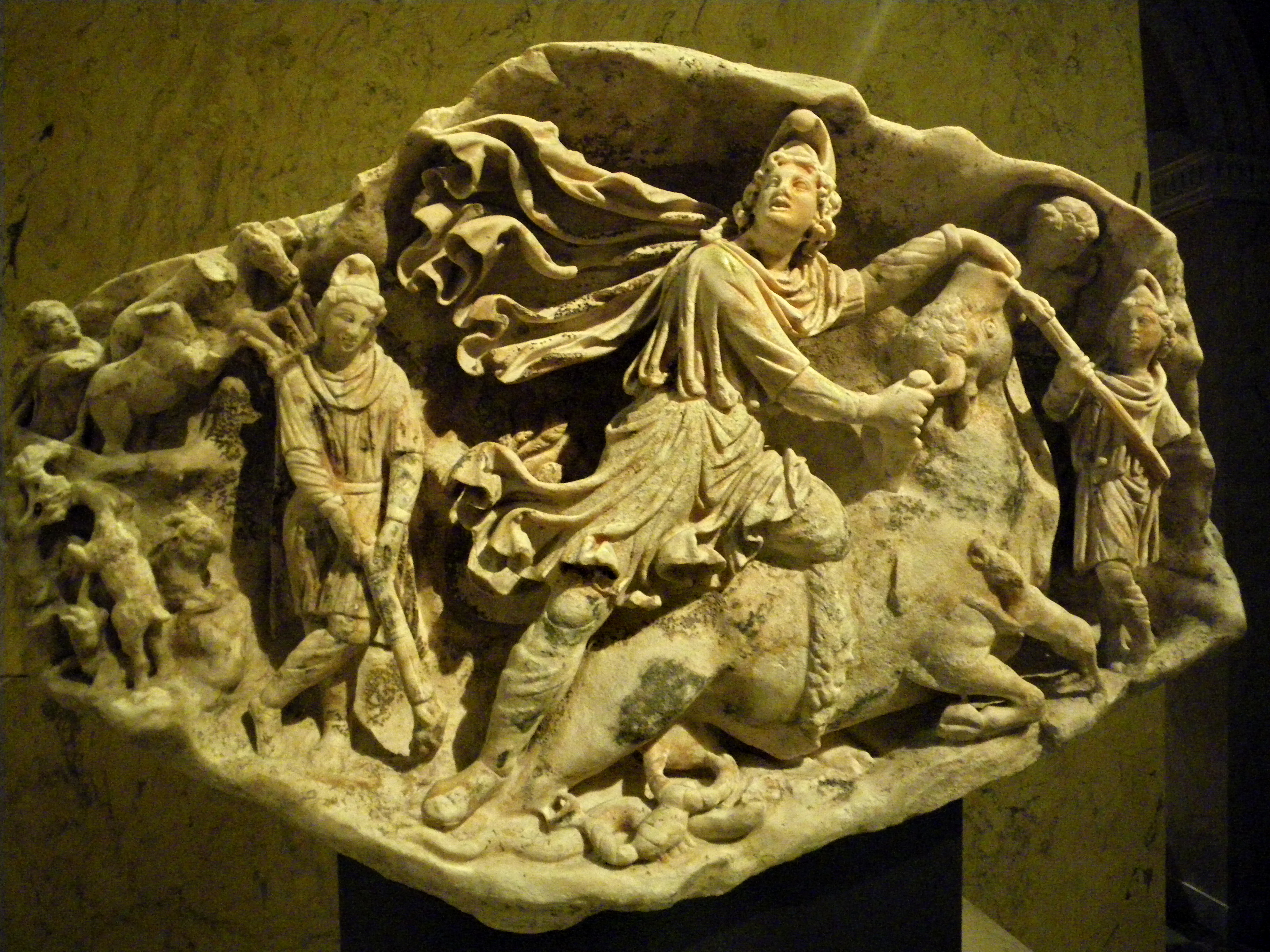
        A Mithraic "tauroctony"--Mithras killing a sacred bull
        This is the main icon in a Mithraic temple.
        There are multiple reasons historians propose as to why December 25th was chosen as the date on which we celebrate Christmas. Probably the most commonly heard argument is that the Church “Christianized” a pagan celebration. At that time of the year, the Mithras Cult celebrated the Birth of the Undying Sun. It happens just after the winter solstice, the shortest day of the year (December 21st); beyond that, the days start getting longer again. The ancients obviously weren't as accurate with their observations of the heavens as our contemporary equipment is, so we can easily forgive them for being 4 days off. The Christians may very well have seen something good in this celebration of the Undying Sun. The sun, which begins to increase (in the Northern Hemisphere) after this time, can be seen as a metaphor for Christ bringing light into the darkness. In addition, the idea of the “undying sun” was a common Christian symbol for Jesus, the “undying Son” (or, rather, He who conquered death). St. John Chrysostom wrote: “Who is indeed so unconquered as Our Lord? If they say that it is the birthday of the Sun, He [Jesus] is the Sun of Justice." (Of Solstices and the Equinox, 386 AD) The Church is never opposed to finding what is good in other religions, pointing out how that good is a “preparation for the Gospel” (CCC 843), separating it from what is not good, and elevating it to the use of honoring God.

        Not only was this idea related to the extra light after the solstice, but also to every sunrise. In early Christianity, the worshippers turned from their Jewish gaze, which was toward the temple. (All synagogues faced where the temple was in Jerusalem and Jews would point themselves toward the temple when they prayed.) The Christians, recognizing that the sacrifice of Jesus on the cross ended the need for the temple sacrifice, re-oriented their prayer direction. They faced east both to greet the metaphor of the rising sun/Son and to look for His return from the east. This is evidently seen in older liturgies where the priest faces the same direction as the people and most older churches are built so that all the worshippers face east. 
        The difficulty of arguing that Christmas was set on December 25th to Christianize a pagan holiday is that many suggest the motive would have been an attempt to appease the pagan converts who were used to celebrating at this time of the year--as if Christianity would seem more attractive if people were able to still have a celebration at this time of year. Speculation on the attractiveness of merely celebrating a timely festival aside, the more serious challenge to dating Christmas based on the Mithras festival comes when we realize that the Mithras cult was a geographically small group. It wouldn’t make sense to Christianize a holiday of a local group to appease the whole of Christianity's pagan converts. Perhaps it was an influence on the decision, but I don’t think it was by any means the main reason.
        The second reason posited for December 25th is that, on that date in the year 325 AD, the Council of Nicea promulgated the doctrine of the Homouusis--the statement that Jesus, the Son, is consubstantial, “one in being,” with the Father, meaning that He is everything that the Father is, except the Father. The anniversary of this date may have had some influence over setting the date for the celebration of Christmas. Although, if the celebration of Christmas goes back even farther than 325 AD (as some historians believe), then the influence might just as possibly have gone the other way.

        The third reason for the selection of December 25th requires us to look into Jewish folklore. I'm still trying to find a solid source for this, but I've been told that there was a tradition in the Jewish culture that great prophets were conceived and would eventually die on the same day of the year. Jesus died on what was, in the Jewish calendar, the 14th of Nisan (our March 25th). On March 25th, we celebrate the Solemnity of the Annunciation (the angel Gabriel coming to Mary, announcing the good news that she will bear God in her womb). At the Annunciation, Mary’s Fiat (yes, acceptance, "Be it done unto me according to your word") was her response to God. She was open to the Holy Spirit and through that openness, the Holy Spirit conceived Jesus in her womb. March 25th is the day we celebrate Jesus’ conception in Mary’s womb. Nine months to the day after March 25th (enough time for a woman to carry a baby to term), we celebrate Jesus’ birthday. These aren’t necessarily the exact dates on which these historic events happened, but for purposes of selecting a day to celebrate Christmas and the Annunciation, the Church may have been influenced by it's Jewish roots and set the date of Christmas based on the tradition of Jewish lore.
        We celebrate Mary’s conception and birth in the same way. Mary was conceived immaculately (without original sin), in her mother’s (St. Anne’s) womb. We celebrate the Immaculate Conception on December 8th. We celebrate Mary’s birthday nine months later on September 8th.
        We also remember that, at the time of the Annunciation, Elizabeth was 6 months pregnant (with John the Baptist in her womb) and Mary rushed off to Judea to help Elizabeth for the last 3 months of gestation. Three months after the Annunciation, we celebrate the Solemnity of the birth of John the Baptist (June 24th). This is interesting because whereas Jesus' birthday marks the change from shortening days to lengthening, John’s birthday (in contrast to Jesus’) comes as the days begin to get shorter--this follows in line with his quote: “He must increase; I must decrease.” [John 3:30] After Jesus’ birthday, the days increase. After John’s birthday, the days decrease. Again, these may not be the exact dates on which the historic events took place, but their placement in the calendar is poignant for celebration and for teaching the faithful.
        Regardless of the reason for December 25th, the timing is also interesting. Jesus’ birthday comes at the very end of the calendar year. This echoes the idea that all of ancient history (BC) anticipated His coming and all of contemporary history (AD) looks forward to His Second Coming at the end of time. Consider the verse in Hark the Herald Angels Sing: “Late in time behold Him come.” Also, if you go to the day Mass on Christmas, you would hear Paul’s words to the Hebrews (1:2) “in these last days, [God] has spoken to us through the Son.” The final preparations of the calendar year are summarized in the season of Advent, waiting for the celebration of the Lord’s coming. Christmas, however, doesn’t end on Christmas Day. It is so large of a celebration that it gets spread over an octave (8 days), taking up the rest of the year and spilling over to the first day of the next year, after which, the celebration continues in the season of Christmas, which lasts until the Feast of the Baptism of the Lord. Christmas is, then, the culmination of the calendar year, bridging us into the next year to celebrate the cycle all over again--just as Christ bridges the gap between this life and the next.


        Taking it up an Octave

        Octaves are interesting celebrations in the Church. They extended the celebration of a particularly Holy day into 8 days. The Octave of Christmas begins on Christmas Day and ends eight days later (inclusively) on January 1st, the Solemnity (and Holy Day of Obligation) of Mary, the Mother of God (defined by the Council of Ephesus in 431 AD). Each day in that octave is celebrated as Christmas Day all over again. If we pay attention to the prayers at Mass on those days, we will notice the theme of Christmas in a present tense as opposed to a past tense. When praying the Liturgy of the Hours on those days, one reuses the Hymns, Antiphons, Psalms, and Canticles from Christmas Day.

        The Christmas Octave is interesting in another notable way. If we celebrate Jesus’ birth on the first day, then, on the 8th day, we also recognize the significance of His circumcision. All Jewish boys were circumcised at 8 days old. This was the manner of entering them into God's covenant. This made them members of God’s family. Of course, for Jesus, the eternal Son of God, circumcision as entrance into God’s family would seem unnecessary. However, circumcision was the law, and Jesus, who was “born under the law” (Gal. 4:4) and obedient to both the law and his family, was a model Jew. Mary and Joseph had Him circumcised. With this act, we can also see Jesus’ flesh being offered to God--the flesh, which He received from Mary, his Mother. We begin the New Year, on the 8th day after the celebration of Jesus’ birth. We begin the New Year with both the celebration of Mary’s Motherhood of God and, with it (in a way), we celebrate Jesus’ circumcision.

        There used to be more octaves in the year, but currently the only other octave that is officially celebrated is the Easter octave, during which every day is a Solemnity (a high feast day, but not a holy day of obligation). Easter is always a Sunday and the end of the octave is now Divine Mercy Sunday (linking the Resurrection to God’s Mercy). In a certain way, every Sunday is an extended octave of Easter. In honor of Jesus' Resurrection, we come together every Sunday to celebrate the Lord’s Day--a continual octave of Easter.

        Although not an official octave, we celebrate the Assumption of Mary (body and soul) into the glory of Heaven on August 15th, and eight days later (inclusively), we celebrate the Coronation of Mary as Queen of Heaven and Earth.

        My “Truelove” Gave to Me...

        The Christmas Season extends beyond the octave (forwards, not backwards, as our retail society might have you believe). Think of the 12 Days of Christmas song. That song is about the Christmas Season on the old calendar, which lasted 12 days. It ended on January 6th, the Solemnity of the Epiphany. There are 13 days in there, so (if I’m not mistaken) they didn’t actually start counting the days until the day after Christmas. Today, on the new calendar, Epiphany can be held on January 6th or the Sunday between January 2nd and 8th, but the Christmas Season doesn’t end there, it lasts until the Baptism of Jesus (the Sunday after January 6th or Monday if the 6th is a Sunday and Epiphany is celebrated then).


        Critique of Criticism

        Recently, I have come to notice that some people criticize Christianity for celebrating Christmas on December 25th. They claim that because Jesus was probably not born on that day and that the Church simply "Christianized" a pagan holiday, this somehow refutes all of Christianity's claims . . . I know. When you actually write it out, the syllogism falls apart by itself, but let's just cover it just to be sure. When we celebrate a festival, what is more important, that we celebrate together or the fact that the date is accurate? It wouldn't really be a festival if we didn't celebrate it together on the same day; would it? If the celebration of Christmas was such that there was no set date, it would be a chaotic mess, with people celebrating not only on December 25th, but on all sorts of other days, relatively few on the same day. So, we must admit that, if we are going to celebrate Christmas, we must set a date. If we see elements of truth in certain celebrations of other religions, do we admit that those religions must be correct, too? Yes and no. Yes, we admit that what pieces of the truth they have found are true, but they do not possess the fullness of the truth. Nonetheless, there is nothing wrong with recognizing elements of practice that express truth and appropriating such practices as one's own. If the early Christians saw truth expressed in celebrating a festival as the sun's course appears to change for the better, it would only seem good that they make their own festival at that time to express the Son's appearance to change humanity for the better. Whether the Mithras cult had an influence on the celebration of Christmas or not, it wouldn't make any difference as to legitimacy of Christianity.


        Preparing to rejoice in the celebration of the birth of our Lord,
        - Casey

        Saturday, December 4, 2010

        The Sacrament of Reconciliation (Penance, Confession, Forgiveness)


        On Thursday, our 2nd graders received their First Reconciliation. Beforehand, we invited the families into our parish hall for some last minute preparation. In order to help them better understand Reconciliation, I distributed flyers with the information below and gave an oral presentation on the information. I've edited a little bit since then, but this post is pretty much what we gave them:


        God wants each of us to be in a good relationship with Him and with other people. When I sin, I hurt those relationships. Every time I do something bad, I offend other people. More importantly, I offend God, whom I should love above everything. Small sins (venial sins) offend those relationships and they hurt my soul. Serious sins (mortal sins) completely separate me from God, break my relationships with others, and seriously damage my soul.

        By human power alone, these broken relationships cannot be re-established--we can't just say we're sorry to heal the whole relationship; it isn't sufficient (that's how great the effect of our sins is). To fix this, God took on human flesh and became a man. He taught, healed people, and forgave people’s sins. Ultimately, He offered His life to cancel the debt of all our sins and to reconcile us to Himself--that's how much He loves us and wants us to be in a good relationship with Him.


        Jesus gave us sacraments to apply His crucifixion to us, so that EVERY person could be forgiven. Baptism forgives Original Sin (the sin we inherit from Adam & Eve) AND it forgives any actual sins we have committed up to that point.
        • "Go therefore and make disciples of all nations, baptizing them in the name of the Father and of the Son and of the Holy Spirit, teaching them to observe all that I have commanded you." [Matthew 28:19-20]
        • "Repent, and be baptized every one of you in the name of Jesus Christ for the forgiveness of your sins" [Acts 2:38]
        Baptism forgives sins, but someone can only be baptized once--as the creed states, “we believe in ONE baptism.” If someone commits sins after he has been baptized, he cannot be baptized again to be forgiven for those sins.

        To forgive sins after Baptism, Jesus gave us the sacrament of Reconciliation. Jesus gave His priests the authority to forgive sins in His name. During confession, Jesus forgives us through His priest. Jesus works through His priests. When we go to Confession, we're actually confessing to God through the priest.

        • "The Son of man has authority on earth to forgive sins." [Matthew 9:6]
        • "As the Father has sent me, even so I send you." [John 20:21]
        • "They glorified God, who had given such authority to men." [Matthew 9:8]
        • "He breathed on [the apostles], and said to them, 'Receive the Holy Spirit. If you forgive the sins of any, they are forgiven; if you retain the sins of any, they are retained.'" [John 20:22-23]
        • "If we confess our sins, He is faithful and just, and will forgive our sins and cleanse us from all unrighteousness." [1 John 1:9]
        • "God, who through Christ reconciled us to Himself and gave us the ministry of reconciliation . . ." [2 Corinthians 5:18]
        • "Confess your sins to one another . . ." [James 5:16]
        • "Many also of those who were now believers came, confessing and divulging their practices." [Acts 19:18]
        To restore each of our relationships with Him, God has given us the Sacrament of Reconciliation.

        It only takes one good confession to completely wipe away the guilt of my sins and restore me to a perfect relationship with God. No matter how sinful I've been, no matter how far away from God I am, no matter how long I've been away, it only takes one good confession to be back in proper relationship with Him--that's how strong the power of the Crucifixion is, and that power is applied to us through the sacraments.

        In the prayer that Jesus taught us, we pray “forgive us our trespasses [sins] as we forgive those who trespass [sin] against us.” [Matthew 6:12] An integral part of being forgiven is forgiving other people. If we really want to be forgiven, we need to first forgive the people who have offended us. Forgiveness does not mean we say that their behavior was good; it means that we no longer hold a grudge against the person for having offended us.

        Trying to stay in a great relationship with God,
        - Casey

        Catholic Ads

        Pages